WHY CLARITY BREAKS AT SCALE

Clarity feels straightforward when communication is small. It becomes structurally complex the moment it begins to scale – and the model most organisations rely on to maintain it was never designed for what scaling now means.
CLARITY AS A MATTER OF CRAFTFor most of the history of brand communication, clarity was maintained through craft and attention. A small team, a shared understanding, a review cycle that caught problems before they compounded. This model worked because it was proportionate – the volume of communication was manageable, the number of people producing it was limited and the conditions under which it was created were controlled.
Clarity, in this model, was something that skilled people produced and careful processes protected. It was personal. It depended on the judgement of individuals who understood the brand, cared about the output and had enough time to get it right. When those conditions held, clarity held with them.
THE MULTIPLICATION PROBLEMScale changes the nature of communication fundamentally. More teams create more content. More channels require more variation. More tools generate more output. And more AI produces more language than any review process can meaningfully assess in real time.
Each additional person producing content introduces another interpretation of what the brand should sound like. Each additional channel introduces another context in which tone must be calibrated. Each additional AI tool introduces another point at which governed structure must be present or its absence will be felt. The result is not that clarity becomes harder to achieve – it is that the model required to achieve it changes entirely. Craft and attention cannot scale with output. Something structural must replace them.
"AS COMMUNICATION EXPANDS ACROSS AN ORGANISATION, THE MECHANISMS THAT ONCE MAINTAINED CLARITY BEGIN TO FAIL IN PREDICTABLE WAYS."
WHEN CONSISTENCY BECOMES INTERPRETATIONAs communication expands across an organisation, the mechanisms that once maintained clarity begin to fail in predictable ways. Guidelines are interpreted differently across functions. Tone adapts under deadline pressure. Messaging shifts to meet local market requirements. Each of these adjustments is reasonable in isolation. Together they accumulate into drift – a gradual divergence from the clarity the brand was designed to express.
Nobody intends for this to happen. The people making these adjustments are capable, well-intentioned and doing their best to serve the brand within the constraints of their specific context. The failure is systemic. The system was not designed to hold coherence at the scale it is now being asked to govern.
WHAT AI REVEALSAI has brought this systemic failure into sharp relief. When an intelligent system generates language for a brand, it generates from whatever governing structure has been embedded into its operating environment. Where that structure is precise and complete, AI produces language that is coherent, consistent and on-brand. Where it exists only as a guidelines document or a loosely defined prompt, AI produces language that is plausible but imprecise – close enough to pass a quick review, different enough to compound drift at scale.
AI does not misunderstand the brand. It reflects exactly what has been defined. And in most organisations, what has been defined is insufficient for the precision that AI-scale communication demands. The volume and velocity of AI-generated content means that whatever gaps exist in the governing structure are no longer occasional problems. They are systemic ones, reproduced at speed across every channel simultaneously.
WHY MORE EFFORT FAILSThe natural response to failing clarity is to apply more effort. More detailed guidelines. More thorough review. More alignment sessions. More training. More examples. More oversight. This response is understandable – it is the mechanism that worked when communication was smaller and slower – but at scale it reaches its limits quickly.
Effort does not scale with output. The more language is produced, the less feasible it becomes to govern it through human attention alone. The review cycle that could catch problems when a team produced ten pieces of content per week cannot catch the same proportion of problems when AI is producing a thousand. The guidelines that could be internalised by a team of five cannot be consistently applied across a team of five hundred. Clarity cannot be sustained by effort in a system that produces language continuously.
"WHEN COMMUNICATION IS STRUCTURED AS A SYSTEM, COHERENCE STOPS DEPENDING ON EFFORT AND BECOMES A PROPERTY OF THE ENVIRONMENT."
WHAT ARCHITECTURE PROVIDESWhen communication is structured as a system, coherence stops depending on effort and becomes a property of the environment. Meaning is defined at the canonical level and embedded into the workflows, tools and interfaces where language is created. Teams do not interpret the voice – they operate within a structure that makes coherent expression the path of least resistance. AI does not approximate the brand – it generates within governed boundaries.
This is the shift from guidance to governance. From describing how the brand should sound to designing how it actually creates. The organisations that make this shift will do more than simply communicate more consistently. They will build the conditions in which clarity is structural rather than aspirational – a property of the system itself rather than a consequence of sustained individual effort.
WHAT STRUCTURE PROVIDESWhen clarity is designed into a system rather than maintained through effort, it behaves differently. It does not depend on who is creating the content. It does not degrade under deadline pressure. It does not fragment as the organisation grows. It becomes a structural property of the environment in which language is produced – on brand by design rather than sustained by vigilance.
This is the distinction between describing clarity and designing it. Between asking people to maintain it and building systems that produce it. Between a model that worked when communication was personal and a model built for the conditions that now exist. The organisations that make this transition find that clarity stops being something they protect and starts being something the system generates.
"A GOVERNED LANGUAGE SYSTEM MAKES CLARITY THE DEFAULT CONDITION."
CLARITY AS A SYSTEM PROPERTYA governed language system makes clarity the default condition. When meaning is defined canonically, when governance is embedded into the act of creation and when AI operates within structured boundaries, coherent output is more than the best-case scenario – it is the expected one. The system produces clarity because it was designed to. Not because the people working within it are more skilled or more diligent than those working without it.
This is the shift that Brand Language Architecture makes possible. And it is available now, to any organisation willing to treat language as the infrastructure it has always been rather than the output it has typically been managed as.
THE QUESTION THAT REMAINSClarity does not break at scale because the model that organisations rely on to produce it was never designed for scale. The question facing every organisation that communicates at volume is not whether clarity is important – it always has been. The question is whether the system designed to produce it is equal to the conditions now placed on it.
For most organisations, the honest answer is not yet. The guidelines exist. The intent is clear. The investment in brand expression is real. What is missing is the architecture that makes clarity structural rather than aspirational. Building it is not a creative challenge. It is an engineering one.
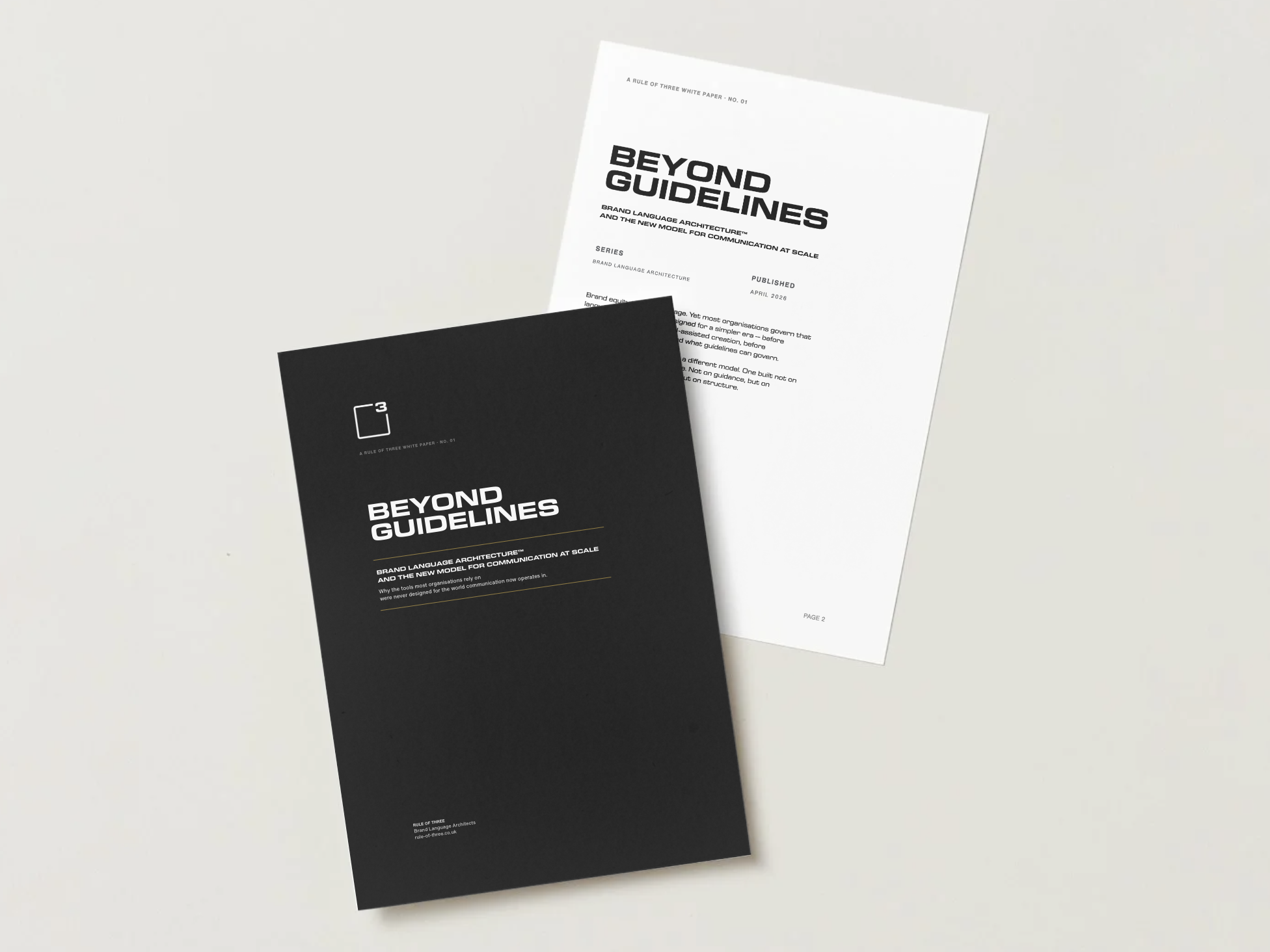
Download White Paper No. 01: Beyond Guidelines
WHITE PAPER NO. 01: BEYOND GUIDELINES.Brand equity lives in language. Yet most organisations govern that language through tools designed for a simpler era.
FURTHER READINGExplore the FAQ – the core definitions of Brand Language Architecture™.
LET’S TALKThis is the work we’ve been designing for — systems that give organisations the structure to communicate with clarity in the age of intelligent communication.
Interested in exploring these ideas further?
