BRAND EQUITY LIVES IN LANGUAGE. MOST ORGANISATIONS ARE NOT PROTECTING IT.

A different kind of conversation is now taking place at executive level. With finance directors, commercial leaders, occasionally with chief executives. The vocabulary they bring to brand is the vocabulary of asset protection.
The honest answer surprises them.
“BRAND EQUITY LIVES IN LANGUAGE. EVERY PLACE A BRAND MAKES ITSELF UNDERSTOOD IS A PLACE WHERE ITS EQUITY IS EITHER REINFORCED OR ERODED.”
WHERE THE ASSET ACTUALLY SITSBrand equity is one of the most carefully protected assets most organisations hold. Strategies exist for protecting it in pricing. Strategies exist for protecting it in product. Strategies exist for protecting it in market positioning, in distribution, in customer experience.
Almost none of those strategies address the place where the asset most lives.
Brand equity lives in language. Every customer email, every product description, every campaign, every press response, every internal narrative, every line of website copy, every AI-generated draft sent on the brand's behalf. These are the surfaces where the brand is recognised, trusted or doubted, and where the value of the asset is reinforced or eroded one piece of communication at a time. For most organisations, this is the layer of the asset that is least protected.
WHY IT HAS NOT BEEN AN EQUITY QUESTIONBrand language has historically been treated as a craft problem. Hire good writers. Define the tone of voice. Train the people producing communication. Review what goes out before it ships.
That model was proportionate to the conditions of its time. When language was produced by a small core team, in controlled conditions, at manageable volume, the equity sitting inside the language was protected by craft and attention.
The model worked because the conditions allowed it to. The locus of protection sat with the small number of people producing the communication, and review caught the drift before it compounded. As long as those conditions held, the equity question and the language question could remain separate disciplines, addressed by different functions, governed by different mechanisms.
“THE BRAND EQUITY QUESTION AND THE LANGUAGE GOVERNANCE QUESTION HAVE ALWAYS BEEN THE SAME QUESTION. THE CONDITIONS HAVE CHANGED IN A WAY THAT MAKES THAT OBVIOUS FOR THE FIRST TIME.”
WHAT HAS CHANGEDThose conditions are no longer the operating environment for most organisations. Language is produced continuously, across every function, in every market, by people and tools the brand team does not always have visibility of.
AI generates drafts at a volume no review process can catch up with. Distributed teams interpret the brand differently in every direction at once. Each piece of communication is a small act of either equity reinforcement or equity erosion. Multiplied across the volume at which language now scales, those acts become significant.
The brand equity question and the language governance question have always been the same question. The conditions have changed in a way that makes that obvious for the first time.
WHY CRAFT-LED PROTECTION NO LONGER HOLDSCraft and attention protected the asset effectively when the asset moved slowly. Volume and velocity have changed how the asset behaves. Language now reaches scale faster than craft-led mechanisms can govern it.
A capable brand team operating with comprehensive guidelines, attentive review and strong creative judgement is doing exactly the work the model was designed for. The work is not failing. The conditions have moved beyond what the work, by itself, can hold. Each individual review is competent. The aggregate volume now exceeds what review can absorb.
This is the structural condition the asset is now exposed to. It is not a failure of craft. It is a mismatch between the protection mechanism and the operating environment, and it widens every cycle the gap remains open.
"THIS IS THE WORK OF BRAND LANGUAGE ARCHITECTURE. THE DISCIPLINE OF DESIGNING THE SYSTEM INSIDE WHICH A BRAND'S LANGUAGE IS CREATED, GOVERNED AND EVOLVED."
WHAT PROTECTION NOW REQUIRESProtecting brand equity in language now requires something more structural than comprehensive guidelines or attentive review. Both of those mechanisms were designed for a smaller-scale operating environment, and they decline at the rate the environment exceeds them.
What protects the equity is a governed system. A canonical source of meaning. A defined message hierarchy. Workflows that determine how language is created and by whom. Authority models that hold human judgement where it matters. Embedded governance that ensures intelligent tools generate language inside the brand's defined parameters rather than improvising approximations of them.
This is the work of Brand Language Architecture. The discipline of designing the system inside which a brand's language is created, governed and evolved.
THE EXECUTIVE-LEVEL RECOGNITIONThe pattern in conversations with finance directors and commercial leaders is consistent. They tend to arrive at the same recognition.
Brand equity is one of the most carefully protected commercial assets the organisation holds. Language is where that equity most directly lives. Language is now the most volatile, most distributed and most AI-exposed surface the brand operates on. The work of governing language is an asset protection exercise, addressed at the structural layer rather than the craft layer.
The conversation does not always end with a project. It almost always ends with the question of who inside the organisation is responsible for protecting the asset where it actually lives. That is the question the discipline exists to answer.
“THE ORGANISATIONS PROTECTING BRAND EQUITY IN PRICING, PRODUCT AND MARKET POSITIONING HAVE THE ASSET SECURED AT EVERY LAYER EXCEPT THE ONE WHERE IT NOW MOST LIVES.”
THE WORK NOW REQUIREDThe organisations protecting brand equity in pricing, product and market positioning have the asset secured at every layer except the one where it now most lives. Closing that gap is the work the conditions of intelligent communication have made structurally necessary.
This is not a brand exercise carried out at the level of expression. It is an asset protection exercise carried out at the level of architecture. A defined source of meaning. Embedded governance. Structured workflows. Human authority preserved where it matters. Intelligent tools operating within governed boundaries rather than improvising on the brand's behalf.
The vocabulary required to commission this work has caught up with the conditions that demand it. The discipline is named, and the work it describes can now be addressed deliberately.
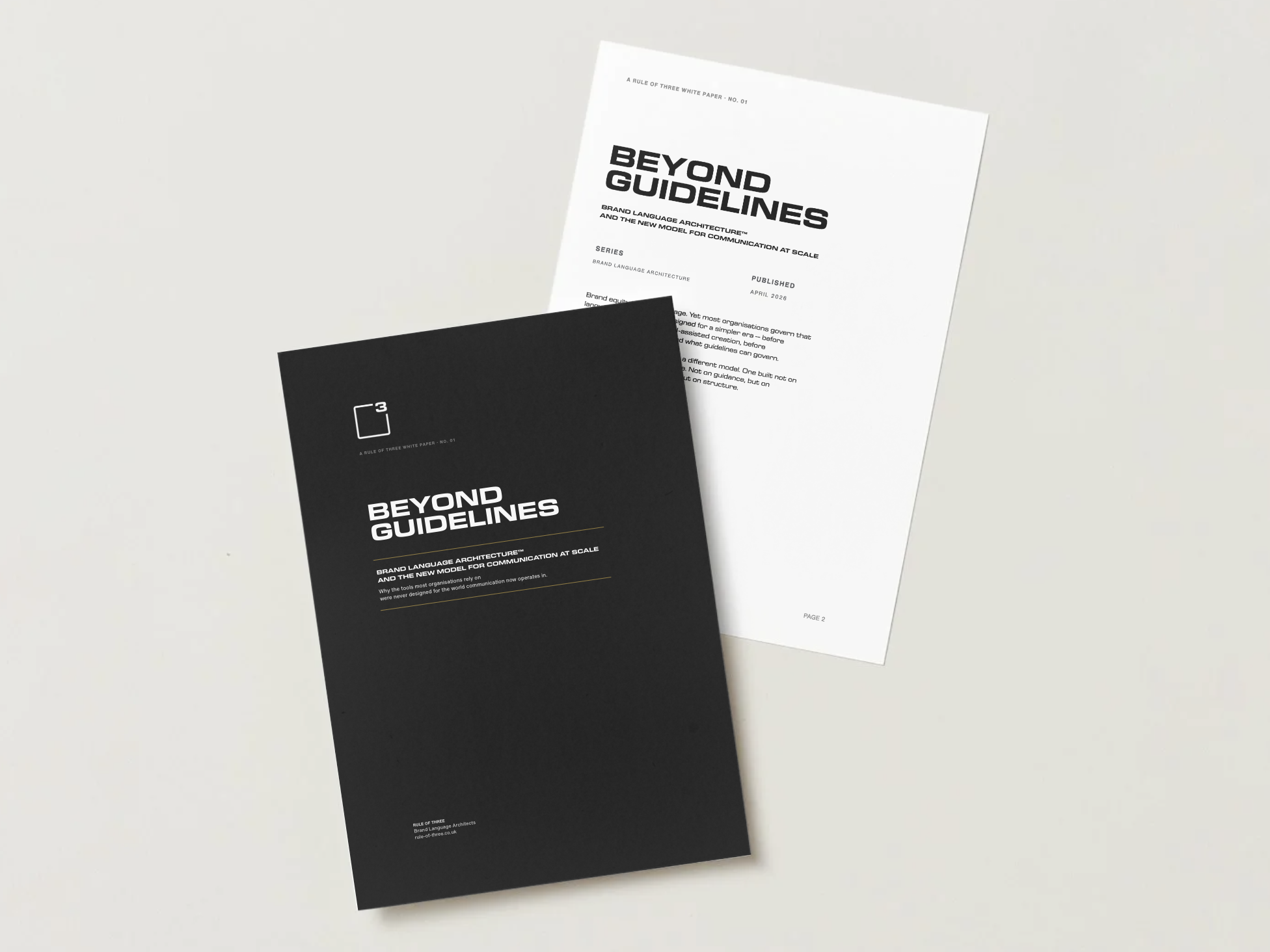
Download the white paper: Beyond Guidelines
WHITE PAPER NO. 01: BEYOND GUIDELINES.Brand equity lives in language. Yet most organisations govern that language through tools designed for a simpler era.
FURTHER READINGExplore the FAQ – the core definitions of Brand Language Architecture™.
LET'S TALKThis is the work we've been designing for – systems that give organisations the structure to communicate with clarity in the age of intelligent communication.
Interested in exploring these ideas further?
