WHAT AI IS DOING TO YOUR BRAND RIGHT NOW

The same question keeps surfacing inside global organisations. Do they know how AI is being used to produce communication on their brand's behalf right now, across every function and market?
The honest answer is rarely yes.
“THE BRAND IS NOW BEING EXPRESSED IN PLACES, BY PEOPLE AND THROUGH TOOLS THAT THE PEOPLE RESPONSIBLE FOR THE BRAND DO NOT ALWAYS KNOW ABOUT.”
THE SHAPE OF AI USE TODAYMost brand leaders are aware AI is being used inside their organisation. What has often not been measured is the shape of that use.
The pattern is consistent across sectors. AI is now used daily, across every function, in every market, to draft customer communications, generate internal updates, prepare regulatory submissions, write product copy, expand briefs, refine campaign language and produce the hundreds of small pieces of communication that make up the brand's actual presence in the world.
Most of this happens through tools individuals chose themselves. Free models. Consumer-grade subscriptions. Browser plugins. Whatever was available when the deadline came. The brand is now being expressed in places, by people and through tools that the people responsible for the brand do not always know about.
IMPROVISATION AT VOLUMEEach individual writes their own prompt. Brings their own context. Provides their own version of what the brand sounds like, drawn from memory and instinct rather than from any governed source. And does this every time, from scratch, because there is no governed structure to work from.
The brief given to AI becomes an improvised approximation of the brand brief. Assembled from memory, from instinct and from whatever the individual believes the brand stands for that day. The long prompt written from scratch, providing context that should already be embedded in the tool, is the most visible symptom of this condition.
It happens at a volume no review process can catch up with, and it accumulates faster than any brand team can see, let alone respond to.
WHY GLOBAL ORGANISATIONS LOOK DIFFERENTIn a small, centralised team, this would be manageable. The brand sits close to the production. Drift is visible. Conversations happen.
In a distributed organisation – multiple geographies, multiple functions, multiple regulatory regimes, hundreds or thousands of people producing content simultaneously – the picture changes entirely.
Each region adapts the brand for its local market. Each function applies it through its own lens. Each individual brings their own interpretation. Together, those interpretations accumulate into something that no longer holds as one voice.
AI does not create this condition. It accelerates what was already happening. Across distributed teams, AI has not been adopted as a strategic decision. It has arrived as an individual one, repeated thousands of times.
“WHAT USED TO BE A BRAND CONSISTENCY QUESTION HAS QUIETLY BECOME AN ACCOUNTABILITY ONE.”
WHY THIS MATTERS IN REGULATED ENVIRONMENTSFor brands operating in regulated industries – financial services, health, certification, professional services, anything where what the brand says carries legal or compliance weight – this picture takes on another dimension.
Drift is no longer only a reputational risk. It is an audit risk. The EU AI Act and emerging governance frameworks now require organisations to demonstrate human oversight of AI-generated content, maintain auditable records and establish clear accountability for what AI produces on their behalf.
In an environment where AI is being used informally and individually, without governed structure, none of those requirements can be met. There is no record of what was produced. No control over the context provided. No defensible line between human authority and AI execution. What used to be a brand consistency question has quietly become an accountability one.
“A MORE CAPABLE AI INSIDE AN UNGOVERNED ENVIRONMENT PRODUCES MORE FLUENT DRIFT. THE FLUENCY INCREASES. THE DRIFT CONTINUES.”
A STRUCTURAL PROBLEM, NOT A TOOLING ONEThe instinct under these conditions is to look for a better AI tool. A more capable model. An enterprise-grade subscription. A different prompt library. Each of these is a reasonable operational response. None of them addresses the underlying condition.
The condition is structural. Language is being produced on the brand's behalf at volume, across distributed teams, by humans and intelligent tools, without a governed source of meaning underneath. The variable that determines the result is the architecture surrounding the act of creation, not the model performing it.
A more capable AI inside an ungoverned environment produces more fluent drift. The fluency increases. The drift continues. What changes the result is structure, embedded into the systems where language is now being produced.
WHAT GOVERNED ARCHITECTURE PROVIDESA Brand Language System defines meaning at the canonical level, embeds governance into the workflows where language is created and provides the structural source from which both human writers and intelligent tools operate.
Inside that architecture, AI generates within governed boundaries rather than improvising approximations of them. Distributed teams operate from a shared, governed source rather than a remembered one. Regulated environments gain the auditability and accountability that informal AI use cannot provide. The brief stops being assembled from memory because the brief is held by the system.
This is the work of Brand Language Architecture: designing the structure that determines how a brand's language operates across people, tools and intelligent systems, under the conditions modern enterprise communication actually presents.
THE WORK AHEADMost organisations sense something is happening. Few have measured the scale of it. Fewer still have a defensible answer to the question of what their brand is actually saying right now, on their behalf, in places they may never see.
The first step is recognising that this is a structural problem. The next is designing the architecture that addresses it: a defined source of meaning, embedded governance, structured workflows and the human–AI collaboration rules that preserve accountability where it matters.
In the age of intelligent communication, the question of what the brand is saying on its own behalf is one organisations can no longer leave to inference. It has become a question the system underneath the brand needs to be able to answer.
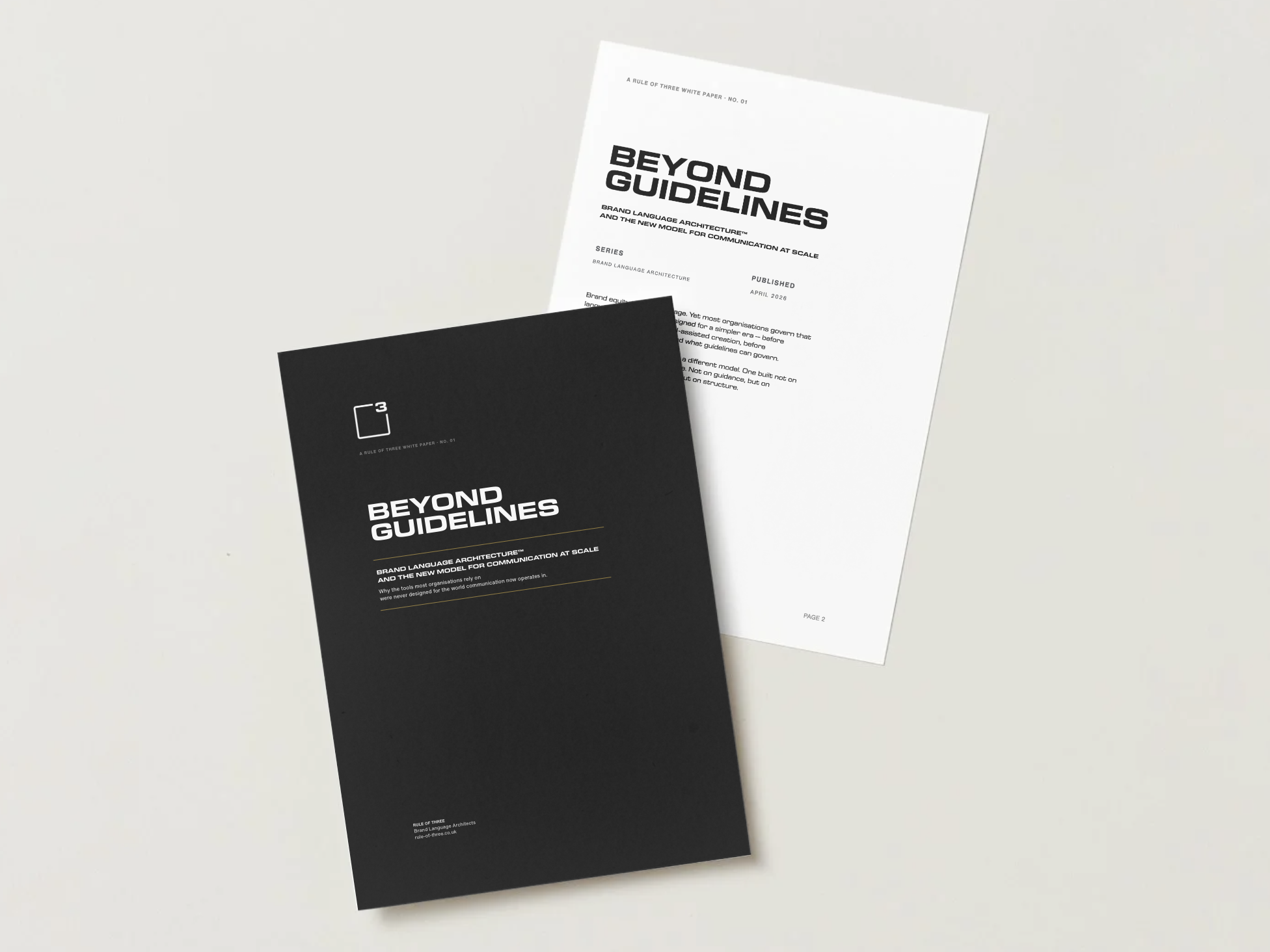
Download the white paper: Beyond Guidelines
WHITE PAPER NO. 01: BEYOND GUIDELINES.Brand equity lives in language. Yet most organisations govern that language through tools designed for a simpler era.
FURTHER READINGExplore the FAQ – the core definitions of Brand Language Architecture™.
LET'S TALKThis is the work we've been designing for – systems that give organisations the structure to communicate with clarity in the age of intelligent communication.
Interested in exploring these ideas further?
