BRAND LANGUAGE HAS OUTGROWN ITS GUIDELINES

For decades, brand communication has operated on a shared assumption: that clearer guidelines produce more consistent communication. The assumption held for a long time.
It no longer does.
WHEN GUIDELINES WORKEDGuidelines were designed for a specific operating environment. A small number of trained people producing a manageable volume of language in controlled conditions. A core brand team. Shared context. Enough time to review.
In that environment, guidelines functioned as a reasonable governance mechanism because the system they were governing was contained enough for them to work. A feedback loop existed that caught drift before it compounded. Most organisations of an earlier era operated this way.
That world has changed almost beyond recognition. The conditions guidelines were built to govern have given way to a different set of conditions entirely, and the model has not adapted with them.
WHAT CHANGEDToday, language is produced continuously across dozens of functions, hundreds of channels and multiple markets simultaneously. Marketing teams create campaigns. UX teams write interfaces. Content teams generate customer communications. Legal produces disclosures. Leadership authors internal narratives.
Each function operates with its own priorities, its own timelines and its own interpretation of what the brand should sound like. Each interpretation is reasonable in isolation. Together they accumulate into divergence.
And increasingly, AI generates a significant and growing proportion of what the brand says in the world, at a speed and volume that human review cannot match. Guidelines were never designed for any of this, and refining them does not change the category of artefact they are.
“A MORE COMPREHENSIVE GUIDELINE IS STILL A DESCRIPTION THAT DEPENDS ON INDIVIDUAL JUDGEMENT TO BE ENACTED CORRECTLY. THE MECHANISM REMAINS INTERPRETIVE AT EVERY POINT OF CREATION.”
THE INTERPRETATION PROBLEMWhen guidelines say 'be clear and human', every writer applies their own understanding of what those words mean inside their specific context. A UX writer reads them one way. A marketing strategist another. A content writer another still.
Each interpretation is reasonable. Each is slightly different. Each contributes to a gradual divergence of the brand's voice that more detailed guidelines cannot reverse, because the underlying issue is the structural reliance on interpretation as the mechanism of governance.
Adding more detail multiplies the surface area across which interpretation occurs. A more comprehensive guideline is still a description that depends on individual judgement to be enacted correctly. The mechanism remains interpretive at every point of creation, regardless of how thoroughly the description is written.
THE SCALE PROBLEMGuidelines are a static artefact in a dynamic environment. Written at a point in time. Distributed to a population that grows and changes. Interpreted differently as the organisation evolves. Without a mechanism for governing how the guidelines are applied, rather than what they say, they decay.
The further language production moves from the people who created them, the less influence they exert. In a large organisation operating across multiple regions, functions and markets, this decay is rapid and compounding.
No revision cycle keeps pace when the operating environment is changing faster than the guidelines can be updated. The artefact ages against the conditions it was designed to govern, and the gap between the two widens with every cycle.
THE AI PROBLEMWhen an intelligent system generates language on behalf of a brand, it does not consult a tone of voice guide. It generates from what is available to it: the prompts it receives, the examples it has been given and the parameters within which it has been instructed to operate.
Without a structured, governed definition of the brand's voice embedded into the system itself, AI produces a version of the brand that is plausible but imprecise. Close, but not correct. Recognisable in broad terms, yet subtly wrong in ways that compound as volume increases.
The organisations most exposed by this are often the ones that believed their brand was well defined. Comprehensive guidelines. Documented tone. Mapped messaging. None of it sufficient for the environment AI has created.
“DESCRIPTION, HOWEVER DETAILED, DEPENDS ON INTERPRETATION TO BE ENACTED CORRECTLY. DEFINITION IS STRUCTURAL.”
FROM DESCRIPTION TO DEFINITIONThe shift required is from describing the brand to defining it. Description, however detailed, depends on interpretation to be enacted correctly. Definition is structural. It produces consistent application by people and intelligent systems alike, because the meaning is bounded and the structure is shared.
A Brand Language System defines meaning at the canonical level, embeds governance into the act of creation and structures the workflows in which language is produced. It does not replace human judgement. It situates judgement inside an architecture that holds its shape under the conditions modern communication operates in.
This is the shift the conditions now require. Description was sufficient for its era. The era has changed.
“WHEN THAT SYSTEM EXISTS, CONSISTENCY STOPS BEING A GOAL PURSUED THROUGH INDIVIDUAL EFFORT. IT BECOMES A PROPERTY OF THE ENVIRONMENT ITSELF.”
WHAT ARCHITECTURE PROVIDESWhen that system exists, consistency stops being a goal pursued through individual effort. It becomes a property of the environment itself.
This is the work of Brand Language Architecture: designing the system behind a brand's voice so that human creators and intelligent tools generate coherent output by default rather than by exception. Guidelines describe how the brand should sound. Architecture determines how it actually creates.
The guidelines model served its era well. The era has changed. The model that governs brand language must change with it. The organisations recognising this are designing the system that replaces them, and the structural advantage that produces compounds with every cycle.
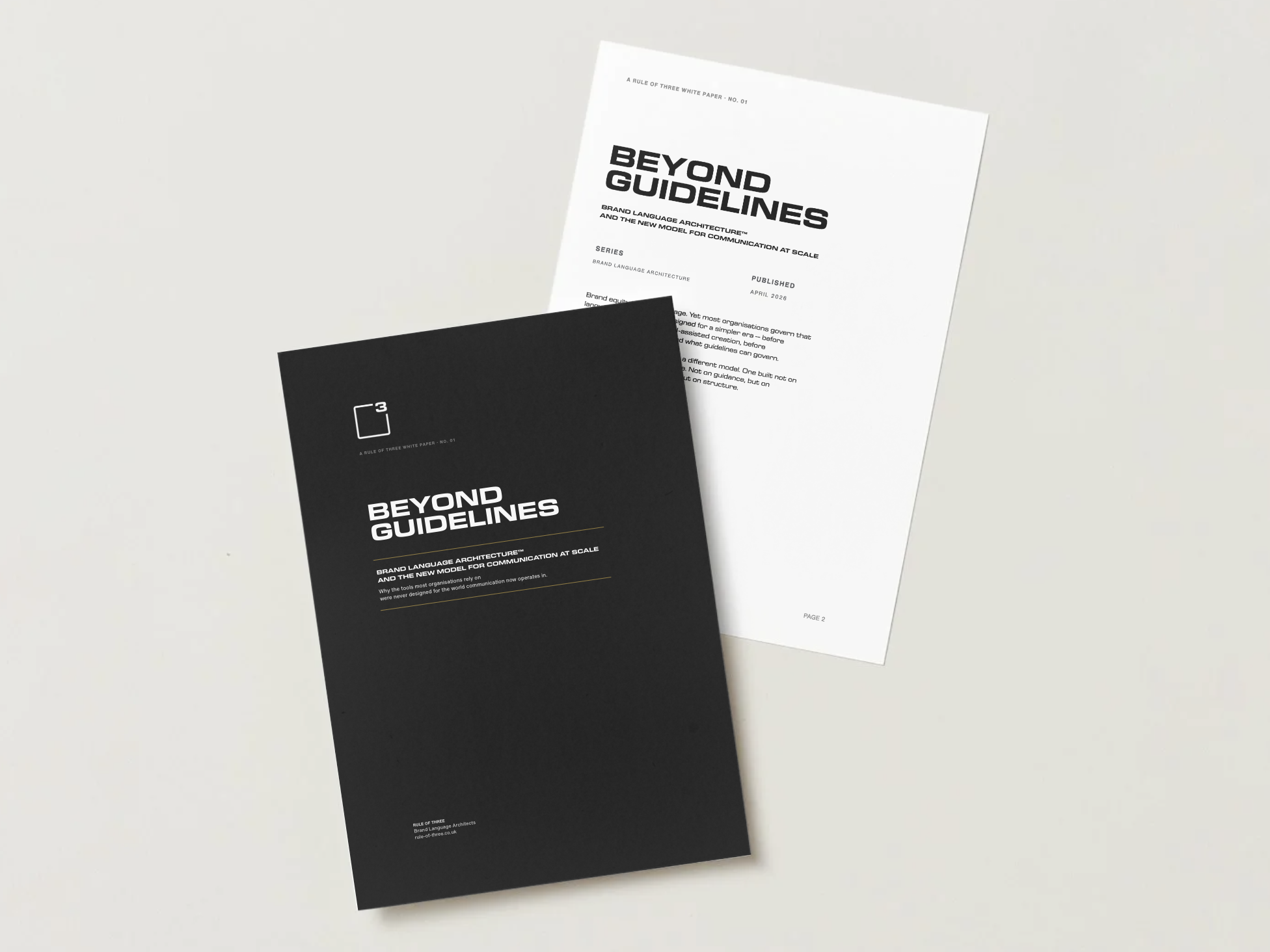
Download the white paper: Beyond Guidelines
WHITE PAPER NO. 01: BEYOND GUIDELINES.Brand equity lives in language. Yet most organisations govern that language through tools designed for a simpler era.
FURTHER READINGExplore the FAQ – the core definitions of Brand Language Architecture™.
LET'S TALKThis is the work we've been designing for – systems that give organisations the structure to communicate with clarity in the age of intelligent communication.
Interested in exploring these ideas further?
START THE CONVERSATION
