BRAND LANGUAGE HAS CHANGED. HERE IS WHAT COMES NEXT.

Brand language has changed. The change is structural, not stylistic. The conditions that produce it have shifted to a degree the previous model was never built to hold.
A different approach is now required.
WHAT THE PREVIOUS MODEL WAS BUILT FORGuidelines were designed for a specific operating environment. A defined number of trained people producing a manageable volume of language in controlled conditions. A small core team. A shared understanding of what the brand meant. A feedback loop that caught drift before it compounded.
In that environment, description was sufficient. Capable people were told how the brand should sound, given examples to work from, and the output was reviewed before publication. The brand held.
That model was proportionate to the conditions of its time. For organisations still operating at that scale, it can continue to be sufficient. Most organisations are no longer at that scale, and the model designed for the smaller environment cannot stretch to cover the larger one.
WHAT THE CONDITIONS ARE NOWCommunication is produced continuously across functions, channels, regions and tools. Marketing creates campaigns. UX teams write interfaces. Content teams generate customer communications. Legal produces disclosures. Internal teams author the narratives that hold the organisation together.
Each function operates with its own context, its own pressures and its own interpretation of what the brand should sound like. Each interpretation is reasonable in isolation. Together they accumulate into divergence.
AI now sits inside this picture as a continuous producer of brand language, generating drafts, expanding fragments and producing content at a volume no review process can meaningfully assess in real time. Where defined structure exists, AI produces language that holds. Where structure does not exist, AI produces language that drifts.
“A MORE DETAILED DESCRIPTION IS STILL A DESCRIPTION. IT STILL DEPENDS ON INTERPRETATION TO BE ENACTED.”
THE INSTINCT TO REFINEThe instinct under these conditions is to refine the existing model. Add more detail. Build more comprehensive guidelines. Capture more edge cases. Train more thoroughly. Each response is reasonable. None addresses the underlying condition.
A more detailed description is still a description. It still depends on interpretation to be enacted. A guideline does not produce language. It tells someone how language should be produced and trusts that the person, or system, interpreting it will arrive at a consistent reading.
At small scale, that trust is justified. At enterprise scale, with hundreds of producers and intelligent systems generating continuously, the same description is read differently in every direction at once. More detail expands the surface area across which interpretation occurs.
THE WRONG CATEGORY OF ARTEFACTThe deeper issue surfaces only when the refinement instinct is followed to its limit. Description, however thorough, cannot be refined into governance. The two operate in different categories.
Description tells someone how the brand should sound. Governance determines how the brand actually creates. Description sits outside the workflow. Governance is embedded inside it. Description is read. Governance is enacted.
The model breaks at scale because description itself is the wrong category of artefact for the work now being asked of it. No quantity of refinement to a description produces governance. Recognising this is the point at which the conversation moves from refining the existing model to designing the model that replaces it.
“WHERE GUIDELINES DESCRIBE, THE SYSTEM DEFINES. WHERE GUIDELINES ARE INTERPRETED, THE SYSTEM IS ENACTED.”
A DEFINED SYSTEMWhat comes next is a different approach. A governed system that defines meaning at the canonical level, embeds governance into the act of creation, structures workflows and authority, and operates as the architecture inside which both human and AI-assisted creation occur.
A Brand Language System is not a more comprehensive guideline. It is a different category of artefact altogether. Where guidelines describe, the system defines. Where guidelines are interpreted, the system is enacted. Where guidelines depend on individual judgement at every point of creation, the system embeds shared structure into the environment in which creation happens.
This is the structural shift the conditions now require, and the substance of what the discipline addresses directly.
THE DISCIPLINE THIS REQUIRESBrand Language Architecture is the discipline of designing the system behind a brand's voice. The structural infrastructure that makes coherent expression possible at the scale, complexity and AI-assisted reality of modern enterprise communication.
It expands what human creativity can do at scale, and it builds the conditions in which both human and intelligent creation can operate without producing drift as a by-product. Inside that architecture, consistency stops depending on individual effort and becomes a property of the environment itself. Speed and clarity stop being opposing forces. AI generates within governed boundaries rather than approximating from inferred patterns.
This is the work the conditions of intelligent communication have made structurally necessary.
“THE PREVIOUS MODEL SERVED ITS ERA WELL. THE ERA HAS CHANGED. THE MODEL THAT GOVERNS BRAND LANGUAGE MUST CHANGE WITH IT.”
WHAT COMES NEXTThe previous model served its era well. The era has changed. The model that governs brand language must change with it.
This is not a refinement of the older approach. It is a structural shift in what brand communication treats as its foundation. From description to definition. From guidance to governance. From a static artefact distributed across a population to a defined system embedded into the environment where language is created.
The organisations recognising this are designing the architecture that the conditions of modern enterprise communication now require. The discipline that operates in this category has a name, and the work that name describes is the work brand communication is becoming.
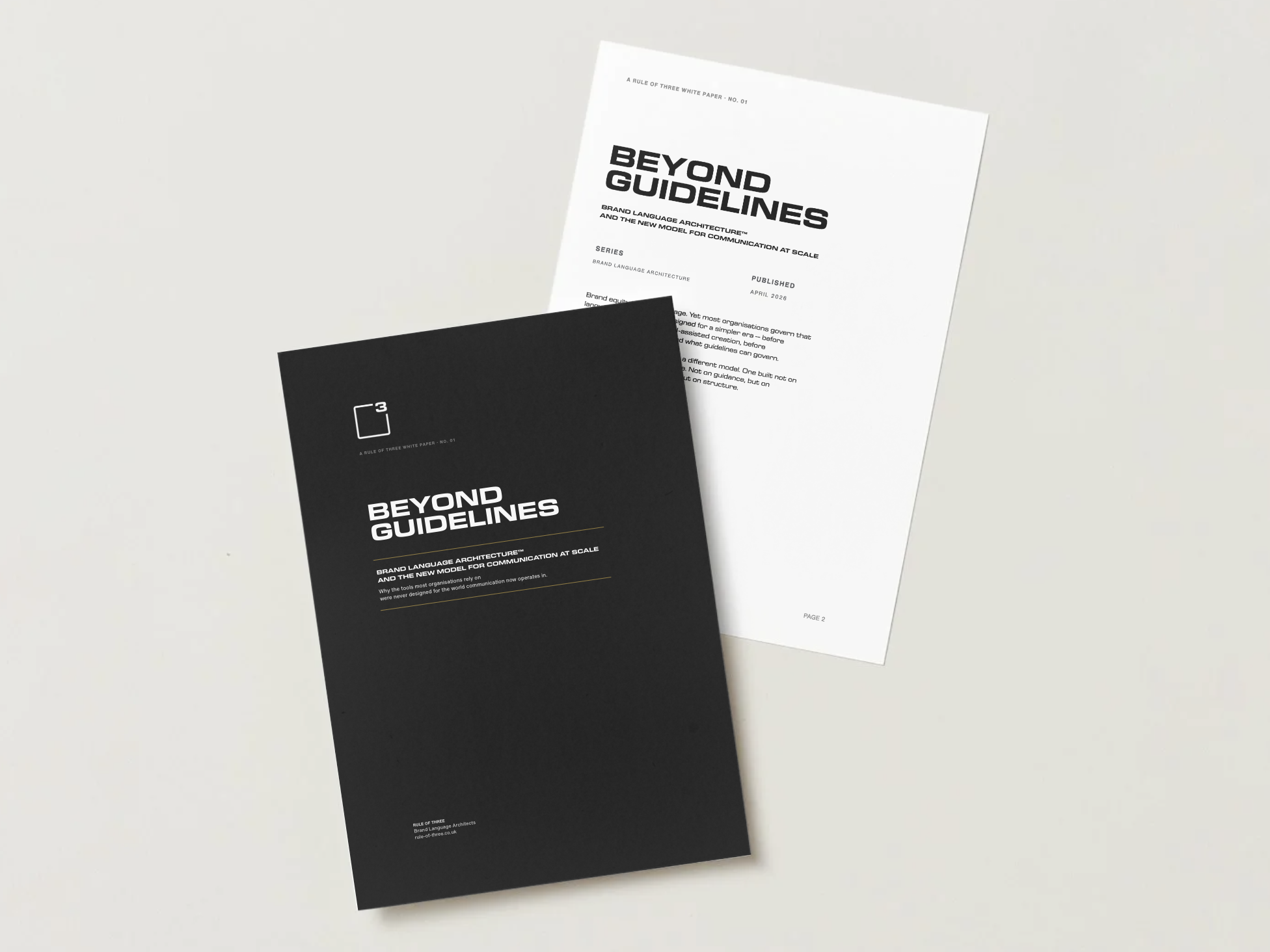
Download the white paper: Beyond Guidelines
WHITE PAPER NO. 01: BEYOND GUIDELINES.Brand equity lives in language. Yet most organisations govern that language through tools designed for a simpler era.
FURTHER READINGExplore the FAQ – the core definitions of Brand Language Architecture™.
LET'S TALKThis is the work we've been designing for – systems that give organisations the structure to communicate with clarity in the age of intelligent communication.
Interested in exploring these ideas further?
