THE DISCIPLINE MOST BRANDS DO NOT YET HAVE A NAME FOR

There is a category of work that organisations have started doing without having a name for it. The work of designing the system inside which a brand's language is created.
That work now has a name.
“THE VOCABULARY HAS LAGGED BEHIND THE PRACTICE. THE CONDITIONS OF MODERN ENTERPRISE COMMUNICATION HAVE NOW MADE THE PRACTICE STRUCTURALLY IMPORTANT ENOUGH TO NAME.”
THE QUIET WORK UNDERNEATHThe work has been going on inside the most coherent global brands for some time. The architecture beneath the voice. The governance beneath the guidelines. The infrastructure beneath the expression.
Organisations doing this work have been building structural systems where most others have continued to refine descriptions. The advantage that produces is significant, and the gap between the two approaches has been widening for several years.
Until recently, the work has been difficult to describe. Brand teams have been commissioning structural projects without quite knowing what to call them. Compliance and risk functions have been asking questions their existing brand frameworks were not built to answer. The vocabulary has lagged behind the practice. The conditions of modern enterprise communication have now made the practice structurally important enough to name.
WHAT TRADITIONAL BRAND WORK ADDRESSESTraditional brand work defines expression. Voice. Tone. Messaging. Creative direction. The output is a description of how the brand should sound, supported by a set of artefacts intended to guide capable people in producing it.
That model was proportionate to the conditions of its time. A small core team produced the majority of language in controlled conditions, and description served the work that needed doing.
The category of artefact that traditional brand work produces is descriptive. It tells someone how the brand sounds, and trusts that the person reading the description will arrive at a consistent reading. Inside the operating environment for which it was built, that trust held. Inside the operating environment most organisations now occupy, the same description is read differently in every direction at once.
“THE DISTINCTION BETWEEN DESCRIBING A BRAND VOICE AND GOVERNING IT IS A DISTINCTION OF CATEGORY, NOT DEGREE.”
WHAT THE NEW WORK ADDRESSESBrand Language Architecture defines something else. It defines the system inside which expression occurs.
A defined source of canonical meaning. A governed hierarchy of message priority. A workflow architecture that determines how language is created, by whom, under what conditions, with what authority. A set of human–AI collaboration rules that preserve human judgement where it matters and permit AI execution where it can be trusted. An evolution mechanism that allows the system to adapt as the organisation, its markets and its tools change.
These belong to a different category of artefact. The distinction between describing a brand voice and governing it is a distinction of category, not degree.
WHERE THE DISCIPLINE CAME FROMThe discipline did not arrive as a theory. It emerged through practice. Two decades of designing language systems for global organisations across technology, financial services, media, health and the public sector produced a consistent observation.
The organisations communicating most coherently at scale were the ones with the most precisely designed systems. Environments where meaning was defined, governance was embedded and the act of creation was structured rather than interpreted. The pattern was observable across sectors, geographies and organisational shapes. Wherever it existed, coherence held. Wherever it did not, drift accumulated.
That observation became a question. The question became a body of practice. The practice produced a discipline, and a system that operationalises it: the Rule of Three Language System.
WHY NAMING THE DISCIPLINE MATTERS NOWDisciplines acquire names when the work they describe becomes structurally important. The work of designing the system behind a brand's voice has reached that point.
The volume at which brand language is now produced, the velocity at which AI generates it on the brand's behalf, and the regulatory accountability forming around AI-assisted creation have together made the architecture beneath the voice a strategic question rather than an operational one.
Describing how a brand should sound is no longer sufficient. The system that determines how it actually creates needs to be defined, governed and made auditable. The vocabulary required to commission, scope and structure that work has been missing. Naming the discipline is what lets the conversation move forward inside the organisations that need it.
“THIS IS NOT AN ADDITIONAL LAYER ON TOP OF BRAND. IT IS THE STRUCTURAL LAYER BENEATH IT.”
WHAT THE NAME OPENS UPNaming the discipline does one thing immediately. It allows organisations to recognise what they have been building, what they have been missing and what now needs to be designed.
It also allows the conversation to move forward. Brand teams can articulate the structural work alongside the expressive work. AI governance can be located inside the language architecture rather than treated as a separate technical concern. Compliance, risk and brand functions can begin to share a vocabulary.
This is not an additional layer on top of brand. It is the structural layer beneath it. Naming the discipline makes that layer visible, addressable and ownable inside the organisations that now need to design it deliberately rather than allow it to form by accident.
THE WORK BRAND COMMUNICATION IS BECOMINGBrand Language Architecture is the discipline of designing the system behind a brand's voice. It is what the most coherent global brands have been quietly building. It is what the conditions of modern enterprise communication now require.
The discipline now has a name, a body of practice and a system that operationalises it. The vocabulary that organisations have been reaching for is available, and the work it describes can be commissioned, scoped and built deliberately.
This is the work brand communication is becoming. Not an evolution of writing, and not a refinement of the existing model, but the structural layer that allows brand language to operate coherently inside the conditions of intelligent communication.
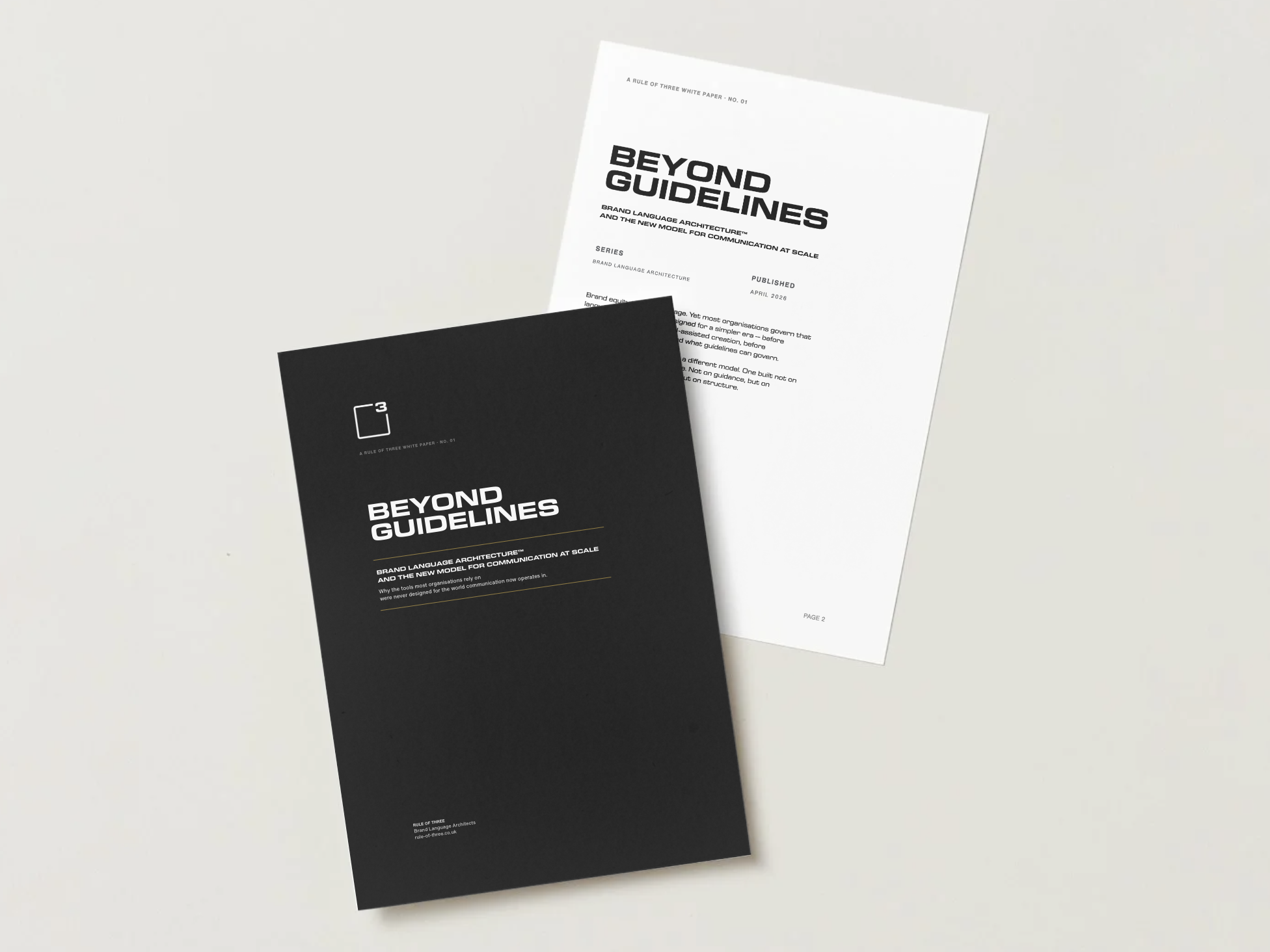
Download the white paper: Beyond Guidelines
WHITE PAPER NO. 01: BEYOND GUIDELINES.Brand equity lives in language. Yet most organisations govern that language through tools designed for a simpler era.
FURTHER READINGExplore the FAQ – the core definitions of Brand Language Architecture™.
LET'S TALKThis is the work we've been designing for – systems that give organisations the structure to communicate with clarity in the age of intelligent communication.
Interested in exploring these ideas further?
