HUMAN? AI? WRONG QUESTION.

The debate about whether humans or AI should write for a brand has become the central question of modern communication. It is the wrong question.
A LONGER-RUNNING PROBLEMFor as long as brands have existed, they have relied on multiple people writing for them. Teams, agencies, freelancers, partners – each interpreting the brand through their own context and judgement.
When many writers operate without a governing structure underneath them, the same pattern always emerges. Tone drifts. Messaging fragments. Meaning decentralises across functions and channels until the brand's coherence becomes something that has to be reconstructed retrospectively.
Organisations have lived with this for decades. The voice was never genuinely consistent. It was manageable because volume was lower and pace was slower. Guidelines, messaging decks and templates created the appearance of order. They did not create the architecture required to sustain it.
"THE BRAND HAS ALWAYS BEEN AT THE MERCY OF WHOEVER HAPPENS TO BE WRITING ON A GIVEN DAY. EACH INDIVIDUAL DECISION IS REASONABLE. TOGETHER, OVER TIME, THEY PRODUCE THE GRADUAL EROSION OF COHERENCE."
THE STRUCTURAL WEAKNESS UNDERNEATHMost organisations do not have a voice problem. They have a structural one. There is rarely enough definition, enough system logic, enough governance or enough clarity around what meaning the brand is built to hold.
Inside this gap, the brand has always been at the mercy of whoever happens to be writing on a given day. Each individual decision is reasonable. Each one fits its moment. Together, over time, they produce the gradual erosion of coherence that organisations recognise but find difficult to diagnose.
This weakness has been present for years. It became easier to live with because human-paced creation gave it room to absorb. Velocity has now removed that room.
WHAT AI HAS REVEALEDAI did not introduce drift. It exposed how unstable the underlying structure has always been. In environments without defined architecture, intelligent systems improvise within the gaps. They mirror whatever patterns they have been given and amplify whatever absence has been left in place.
The output reaches scale faster than any review process can absorb. Inconsistencies that previously accumulated quietly across months now appear simultaneously across thousands of touchpoints. The flaws were already there. AI made them visible.
Velocity has changed the operating physics of brand communication. The model in which writers interpret the brand and review processes catch the drift afterwards no longer holds when output happens continuously.
"THE VARIABLE THAT DETERMINES COHERENCE IS THE ARCHITECTURE SURROUNDING THE ACT OF WRITING. THE WRITER CHANGES. THE SYSTEM IS WHAT REMAINS."
WHY THE HUMAN VS AI DEBATE MISSES THE POINTMost arguments about the future of writing centre on what humans can do that AI cannot, and what AI can do that humans cannot. Empathy, originality, intent, fluency, scale – each side defends the territory it understands best.
These are symptoms of a deeper structural question. Humans originate intent. Systems shape how that intent is expressed. Tools generate the language that carries it. When the system is weak, both human writers and intelligent tools produce output that drifts away from the brand. When the system is strong, both produce output that holds its shape.
The variable that determines coherence is the architecture surrounding the act of writing. The writer changes. The system is what remains.
"A WEAK SYSTEM PRODUCES INCONSISTENT OUTPUT REGARDLESS OF WHO OR WHAT IS WRITING. A DEFINED SYSTEM PRODUCES COHERENT OUTPUT ACROSS BOTH."
THE SYSTEM IS THE OPERATING LAYERA useful way to think about this: humans write with the system held in their heads. AI writes with the system held in its prompts and inputs. Both interpret what they have been given. Both distort when the underlying structure is incomplete. Both align when the structure is sound.
This places the system, rather than the writer, at the centre of the question. A weak system produces inconsistent output regardless of who or what is writing. A defined system produces coherent output across both. The discipline that addresses this directly is Brand Communication System Design – the design of the structures, definitions and governance that determine how language operates inside an organisation.
WHAT STRUCTURAL CLARITY PROVIDESA defined system creates a layer of structural clarity that brands did not previously require. Tone logic, message architecture, meaning rules, governed environments, intelligent constraints, AI-compatible voice definition and multi-channel coherence stop being aspirational objectives and become operational properties.
Inside this layer, writers create with confidence because the boundaries are clear. Teams produce consistent expression without having to negotiate alignment from scratch each time. Intelligent tools behave predictably because the structure they generate from is defined. AI expresses the brand with intent because the intent has been encoded into the environment in which it operates.
Coherence emerges from the structure rather than from sustained individual effort.
THE WORK AHEADThe Human versus AI debate will continue, but it will increasingly look like a debate about the wrong variable. The question that matters is whether the system underneath the writing is defined or absent.
This is the work of Brand Language Architecture: designing the system that determines how a brand thinks, speaks and creates, so that human writers and intelligent systems operate from the same governed source of meaning. The organisations that build this architecture now will scale clarity rather than scale distortion.
In the age of intelligent communication, the writer does not determine the coherence of a brand. The system that surrounds the writer does, and that system is something organisations now have to design.
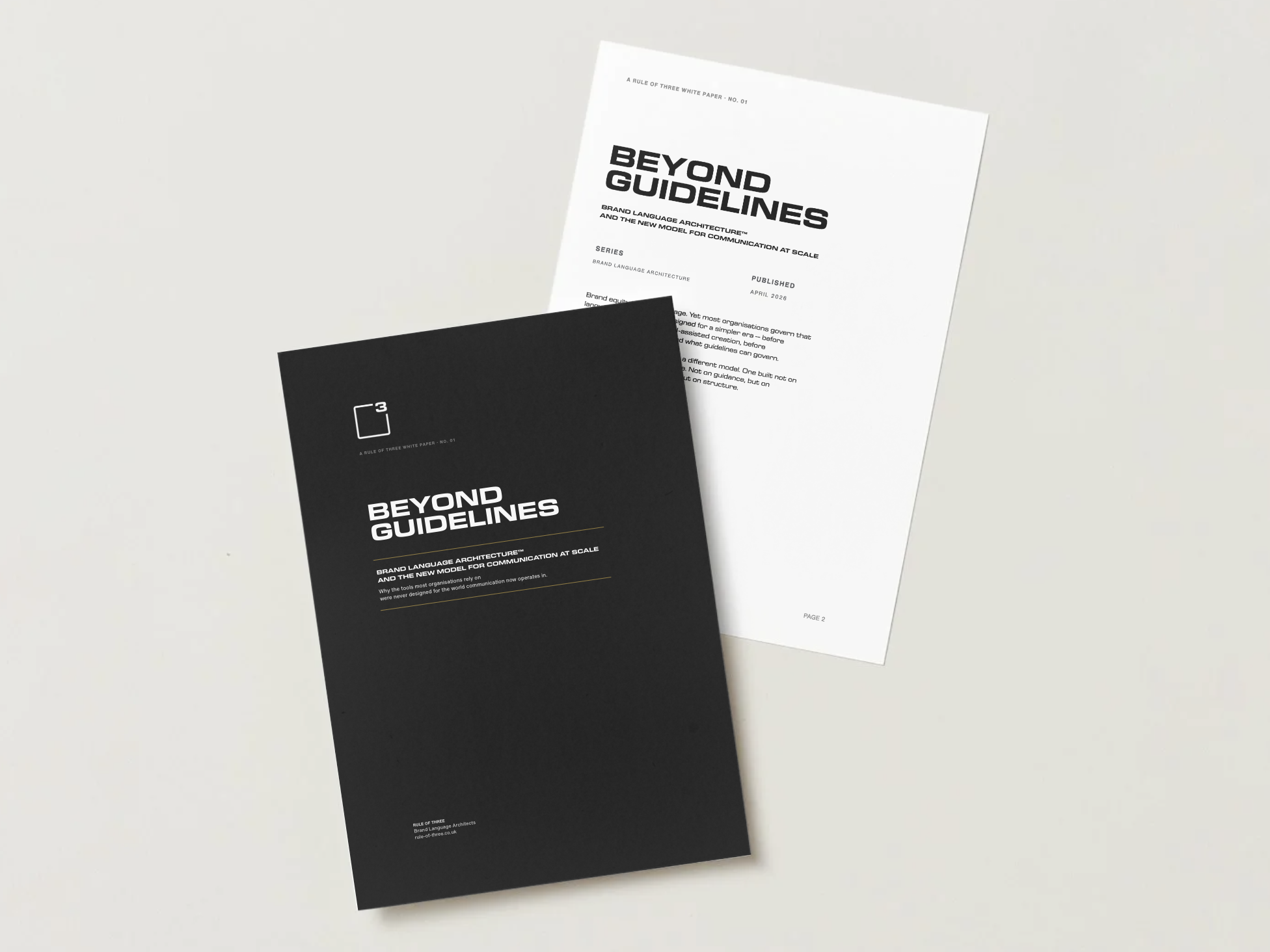
Download the white paper: Beyond Guidelines
WHITE PAPER NO. 01: BEYOND GUIDELINES.Brand equity lives in language. Yet most organisations govern that language through tools designed for a simpler era.
FURTHER READINGExplore the FAQ – the core definitions of Brand Language Architecture™.
LET’S TALKThis is the work we’ve been designing for – systems that give organisations the structure to communicate with clarity in the age of intelligent communication.
