A brand voice guide is one of the most familiar documents in marketing, and one of the least changed while everything around it has.
What a brand voice guide holds
Most follow the same pattern. A voice defined in three or four traits: bold, warm, clear. A page on what the brand stands for. Words to use and words to avoid, and perhaps a glossary of product names so terms stay consistent across markets. Writers and agencies read it at onboarding, and every few years someone refreshes it so that marketing, support and the product still sound like one company.
What it leaves out matters more. How the brand's meaning is ordered, the story it moves through, how the voice shifts between a social post and a board paper, how an email or a product page should be built: little of that is written down. It lives with the people who have been there longest, and they carry it. The guide indicates the voice. Experienced people supply the rest, and someone corrects what slips once it has been written.
The guide indicates the voice. Experienced people supply the rest.
Why voice guidelines break under AI
That arrangement held while people wrote everything, because people could fill the gaps. AI tools cannot. Given a voice guide, a model condenses it into its own short summary and writes from that, drawing on training that contains every brand's language and belongs to none. The more content a team produces this way, the closer the brand moves to the average of its category, and the average is where a brand is least recognizable and least valuable.
The stakes are commercial. Brand equity lives in language: pricing power, trust and long-term value are earned in what a brand says and how it says it. That language is now produced at a volume no review process can read.
A design system for language
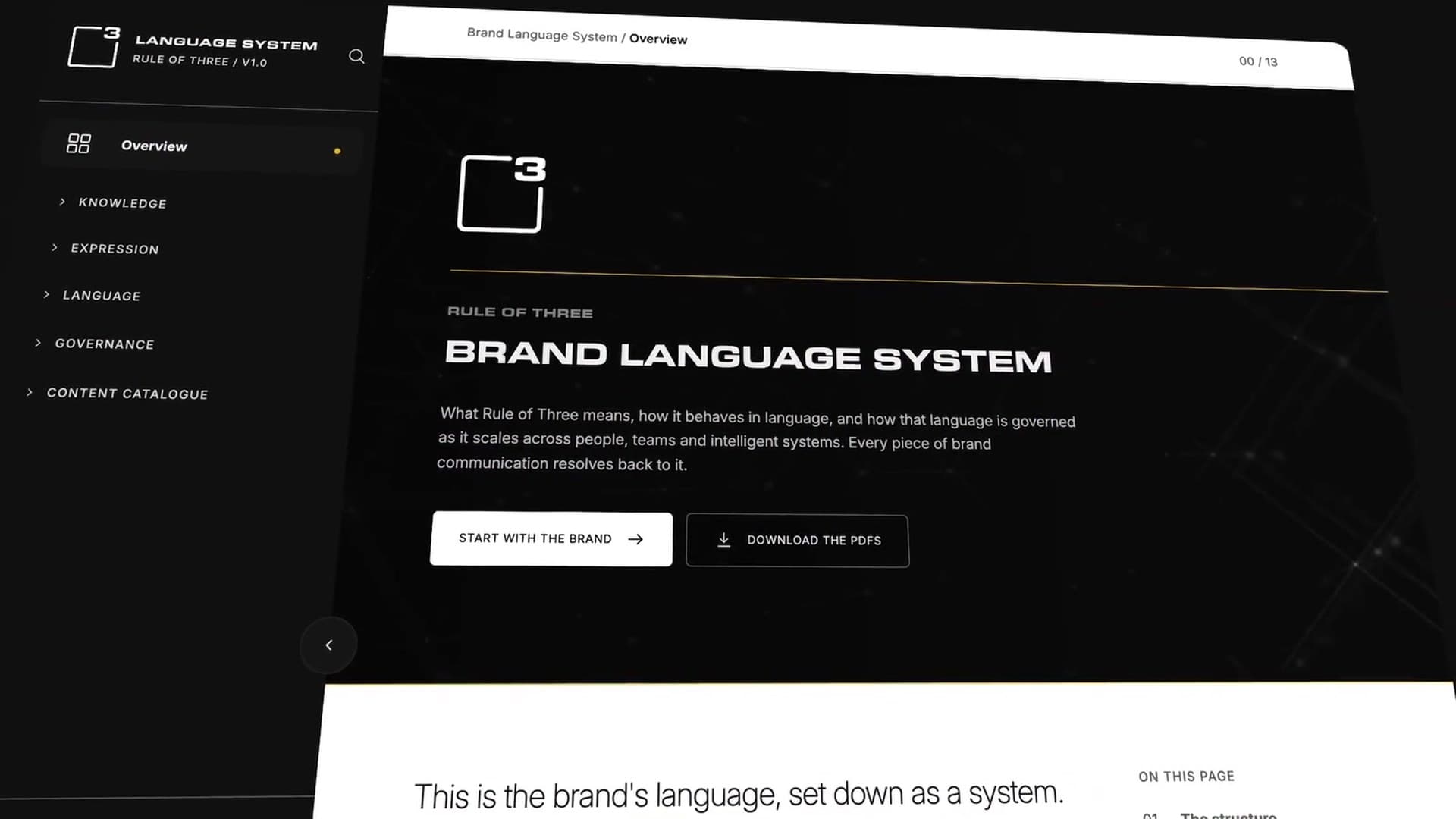
The visual side of a brand solved a similar problem years ago. Colour, type, spacing and components are defined so precisely that a tool can apply them and a new designer gets them right on the first day. A brand's language has rarely had the same treatment. A Brand Language System gives it that treatment: everything the voice guide pointed at, designed in full.
In place of a few adjectives, the voice is designed in forensic detail, including how it behaves and how it flexes across channels and audiences. The brand's knowledge sits alongside it: what the brand means, what must stay true, and how that meaning is ordered into a story. The glossary becomes a signature language with its own conventions. Governance sets out who owns meaning and how it holds as the brand grows. And every content type the brand produces is structured and shown through an annotated, live example, so anyone can open a product email and see how it is built.
The result is one reference that people and AI work from. It can be read, searched and returned to, it downloads in full as PDF, and it belongs to the brand, held independently of any tool.
A guided tour of Rule of Three's own Brand Language System, moving through its knowledge, expression, language, governance and content catalogue, then into Arcroyd.
Building the brand's AI from the system
Arcroyd® is the brand's own AI, encoded from its Brand Language System and set beside it in one environment, with one sign-in. Teams create in Arcroyd and open the system whenever they want to understand the brand. What a writer sees in an annotated example is what Arcroyd applies to every piece it generates.
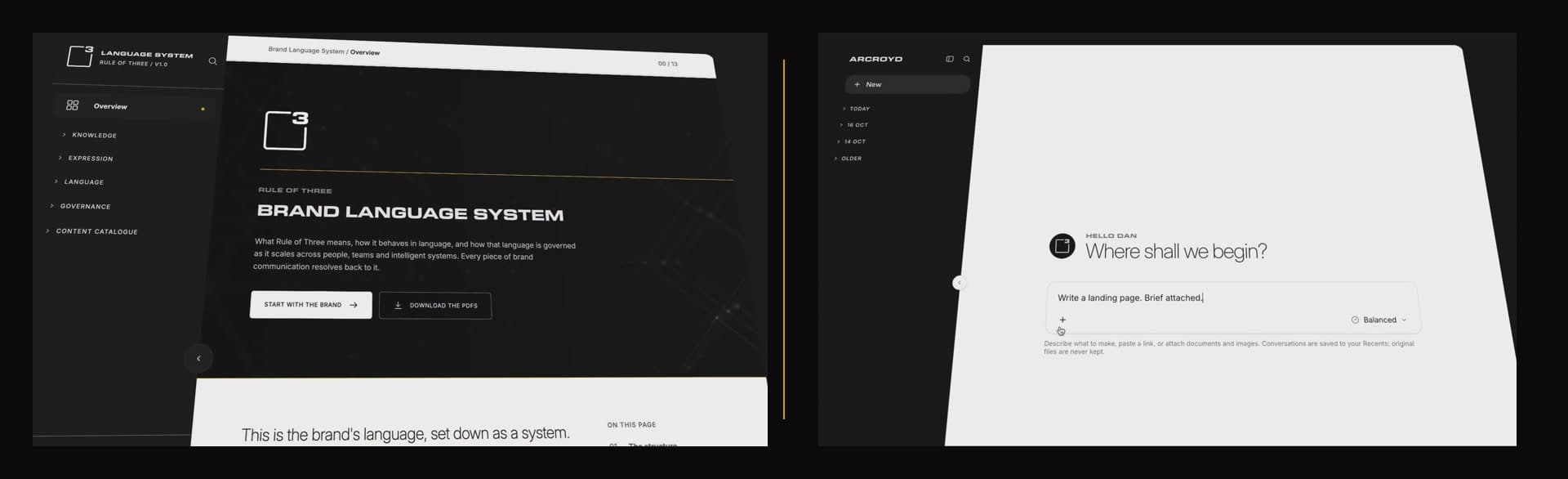
Sequence is the point. Most AI writing tools begin with the model and ask the brand to fit inside it, often by inferring a voice from existing content. Arcroyd begins with the brand, defined in a system the organization owns, and builds the AI from that.
What happened on real work
A global enterprise put Arcroyd through a month-long pilot. Six people produced 83 pieces of real work, each scored by the company's own brand team. The average on-brand score was 4.86 out of 5, and every piece was rated usable for real work.
100%
rated 4 or 5 for on-brand, every piece
9 in 10
better than the way they work now, on the content types built in
96%
drafted in five minutes or less
87%
needed no or only light rework
83 pieces · 6 people · one month, across the content types built in and open-ended work beyond them. Every piece rated usable for real work.
Where the voice guide goes from here
The voice guide still does a useful job: it explains a voice to the people who write in it. Holding that voice steady while AI writes at scale needs more. It needs the language set down as a system, as considered as the one that governs the brand's look, with the brand's own AI built from it.