THE STRUCTURAL PRINCIPLES OF BRAND LANGUAGE ARCHITECTURE

A small number of structural principles govern how a brand's language operates at scale. They emerged through practice rather than theory, surfacing as patterns that repeated across very different organisations.
What follows is a distillation.
"DESCRIPTION IS SUBJECTIVE. DEFINITION IS STRUCTURAL. THE DIFFERENCE BETWEEN THEM COMPOUNDS AT SCALE."
MEANING DEFINED BEFORE GOVERNEDThe most commonly skipped step in brand communication is the most consequential one. Every language system begins with canonical substance: a precise, bounded definition of what the brand means, what it provides and what must remain stable as communication scales. Without that, governance has nothing to protect.
Guidelines describe tone without defining meaning. A defined system requires meaning to be established first, in a form that can be applied consistently by people and intelligent tools alike. The organisations most exposed to AI inconsistency are almost always the ones that have described their brand extensively but never defined it precisely.
Description is subjective. Definition is structural. The difference between them compounds at scale.
GOVERNANCE EMBEDDED, NOT APPLIEDWhen review is the primary governance mechanism, governance fights a losing battle against volume. The more language is produced, the less feasible comprehensive review becomes. Something gets through. Then more things get through. The drift compounds.
The structural alternative is to embed governance into the act of creation itself. Workflows, authority models, structured prompts and defined boundaries that ensure language is created correctly rather than corrected retrospectively. Governance becomes a property of the system that produces the language, rather than a checkpoint at the end of the process.
This shift is what allows clarity to scale alongside volume rather than against it. Review remains valuable. It stops being the mechanism that holds the brand together.
“CLARITY AT SCALE CANNOT BE WRITTEN INTO EXISTENCE. IT CANNOT BE TRAINED INTO EXISTENCE. IT CANNOT BE REVIEWED INTO EXISTENCE. IT CAN ONLY BE DESIGNED INTO EXISTENCE.”
CLARITY AS A STRUCTURAL PROPERTYClarity has historically been treated as a writing problem. Better writers produce clearer language. More careful editing produces more coherent output. The assumption is that clarity is a function of craft.
At scale, the assumption breaks. Clarity emerges from defined meaning, governed hierarchy and consistent structure. When communication is architected as a system, coherence becomes predictable as a property of the environment rather than a function of individual judgement.
The implication is significant. Clarity at scale cannot be written into existence. It cannot be trained into existence. It cannot be reviewed into existence. It can only be designed into existence, by building the system that produces it as a structural consequence rather than a craft aspiration.
“MEANING IS HUMAN. EXECUTION CAN BE ASSISTED. GOVERNANCE DETERMINES WHERE THE BOUNDARY SITS.”
HUMAN JUDGEMENT OVER MEANINGAs AI becomes more capable, the temptation to delegate more to it grows. This is the boundary that holds the discipline together.
Intelligent tools can generate language within a governed system. They cannot define what the brand means, determine the boundaries of appropriate expression or make the judgements that carry commercial, legal or reputational consequence. A well-designed language system preserves the distinction between human authority and AI capability at every stage. It defines where AI operates and where human judgement is required.
That boundary is the line between meaning and execution. Meaning is human. Execution can be assisted. Governance determines where the boundary sits, and how it holds under the conditions modern communication operates in.
A SYSTEM BUILT TO EVOLVEA language system that cannot change will eventually fail in the same way guidelines do, by becoming a static document rather than a living governance mechanism. Brand Language Architecture designs for evolution from the outset.
Stewardship mechanisms, audit cycles and refinement processes are built into the system architecture rather than added afterwards. This matters more now than at any previous point in the history of brand communication. The regulatory environment is changing. AI capabilities are developing rapidly. Markets and cultures are shifting.
A defined system must adapt to all of this without losing the integrity it was built on. A system built to evolve is a system designed to remain accurate to the conditions it operates inside, rather than ageing against them.
WHY THE PRINCIPLES OPERATE TOGETHERIndividually, each principle addresses a specific failure point in the model that came before:
Defined meaning resolves the interpretation problem.
Embedded governance resolves the volume problem.
Structural clarity resolves the craft-aspiration problem.
Preserved human authority resolves the AI delegation problem.
Built-in evolution resolves the static-document problem.
Together they describe a different approach to brand communication. One where meaning is designed rather than described, governance is embedded rather than applied, clarity is structural rather than stylistic, human authority is preserved where it matters and the system is built to grow with the organisation rather than age against it.
These conditions hold together because they share a category. Each one is structural.
WHAT THE DISCIPLINE ENABLESWhen these principles operate as a system, brand communication moves from craft pursued through effort to architecture that holds its shape under load. Coherence stops depending on individual judgement and becomes a property of the environment in which language is created. Human creativity expands rather than contracts, because the system carries the structural weight that previously sat with the writer.
This is the work of Brand Language Architecture: designing the system behind a brand's voice, so that the conditions modern communication operates in produce coherence rather than drift. The principles are how the discipline keeps its integrity. The system is how that integrity reaches the organisations that need it.
The era has changed. The discipline that governs brand language has changed with it.
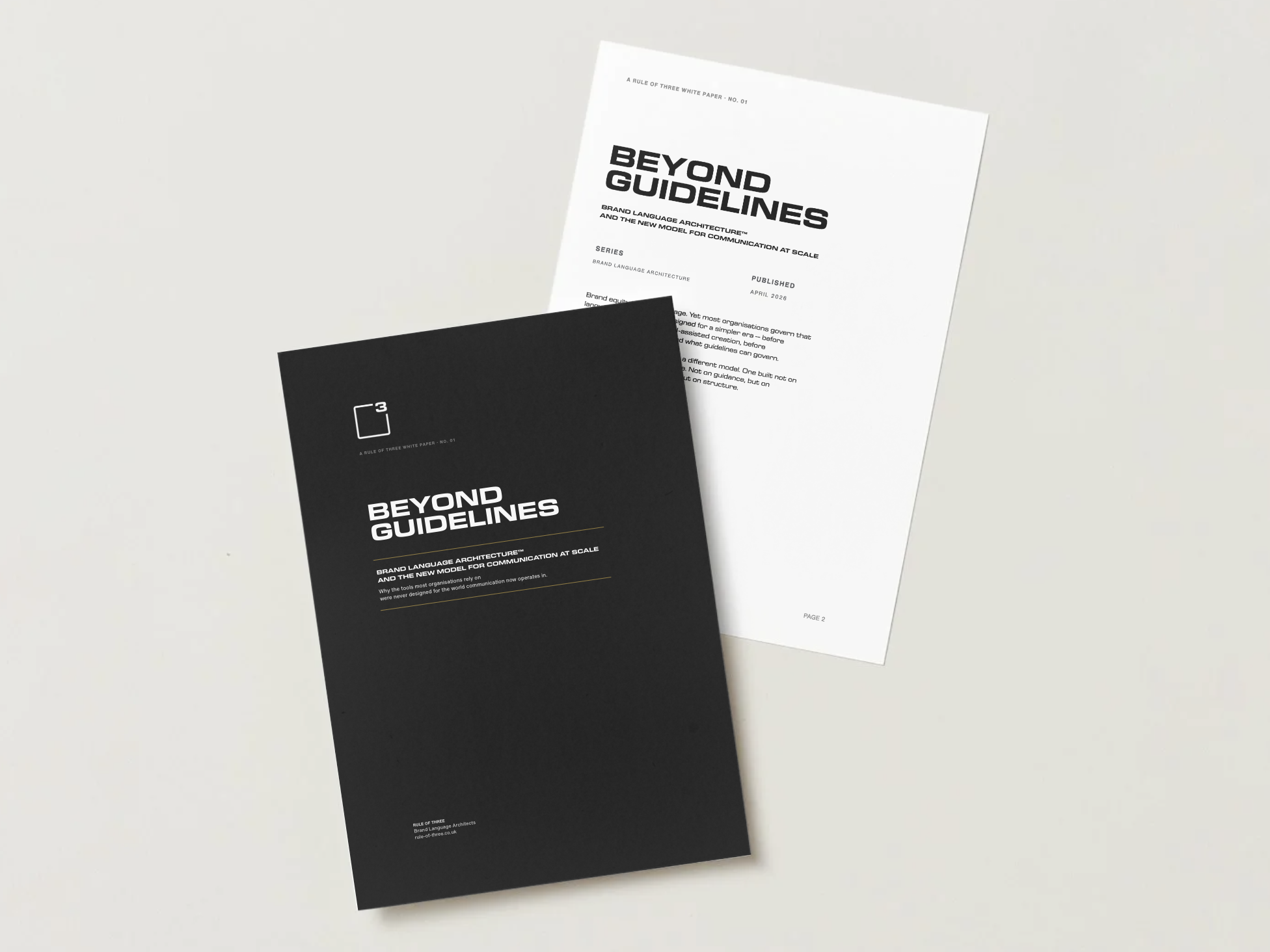
Download the white paper: Beyond Guidelines
WHITE PAPER NO. 01: BEYOND GUIDELINES.Brand equity lives in language. Yet most organisations govern that language through tools designed for a simpler era.
FURTHER READINGExplore the FAQ – the core definitions of Brand Language Architecture™.
LET'S TALKThis is the work we've been designing for – systems that give organisations the structure to communicate with clarity in the age of intelligent communication.
Interested in exploring these ideas further?
