WHY BRANDS ARE LOSING CONTROL OF THEIR VOICE

Every organisation believes it has a voice. Some define it carefully, others document it extensively and many assume it is understood. And yet, in almost every case, the same pattern emerges.
THE FIRST SIGNS OF DRIFTBrand voice begins to fragment quietly. It starts with small adjustments – a UX writer tightening a sentence to fit a constraint, a support agent softening tone for clarity, a regional team adapting language for a local market. None of these decisions is wrong in isolation. Each one is sensible, considered and made in good faith. Together, over time, they erode something that was never designed to withstand this kind of pressure.
The voice that once felt coherent begins to diverge. Teams interpret the guidelines differently. AI tools generate language that is close but never quite exact. Channels multiply and each one pulls expression in a slightly different direction. The brand gradually stops sounding like itself – not because anyone chose to change it, but because the system governing it was never designed for the conditions now placed on it.
"THE VOLUME OF LANGUAGE PRODUCED EACH DAY NOW EXCEEDS ANYTHING A GUIDELINES DOCUMENT WAS DESIGNED TO GOVERN."
THE VOLUME PROBLEMMost organisations significantly underestimate how much language they now produce. Communication is no longer the preserve of a small creative team working in controlled conditions. It happens continuously, across every function, every market and every intelligent tool now embedded in the workflow. Marketing teams write campaigns. UX teams write interfaces. Legal teams write disclosures. Leadership writes internal narratives. Support teams write every customer interaction. And AI writes increasingly everywhere.
The volume of language produced each day now exceeds anything a guidelines document was designed to govern. Each piece of content is a micro-decision about tone, framing and implication – a decision made without structural support, under time pressure, by someone whose primary role is not brand stewardship. At this scale, the risk of brand drift is an inevitability.
THE GUIDELINE TRAPThe instinctive response to brand fragmentation is to refine the guidelines. More examples. More detailed principles. More comprehensive tone documentation. More training. The assumption underlying all of it is that greater clarity in guidance will produce greater consistency in output.
That assumption is structurally flawed. Guidelines describe how the brand should sound. They do not determine how it actually creates. They rely on interpretation, memory, time and alignment between individuals – all of which become unreliable under pressure. A guidelines document sits outside the workflow. Modern communication happens inside it. As output accelerates, the gap between the two does not narrow. It widens.
"WHEN AI PRODUCES THOUSANDS OF PIECES OF INCONSISTENT CONTENT SIMULTANEOUSLY, THE DRIFT HAS ALREADY COMPOUNDED BEFORE ANYONE HAS HAD THE CHANCE TO NOTICE."
THE AI INFLECTION POINTAI has not created this problem. It has revealed it and accelerated it simultaneously. When an intelligent system generates language on behalf of a brand, it does not consult the tone of voice document. It generates from whatever governing structure has been embedded into the system – and in most organisations, that structure is either absent or insufficient. The result is language that is plausible, sometimes convincing, but never precisely right.
More significantly, AI operates at a speed and volume that makes retrospective correction impossible at scale. When a single person produces inconsistent copy, a review cycle can catch it. When AI produces thousands of pieces of inconsistent content simultaneously, the drift has already compounded before anyone has had the chance to notice. The model that worked when communication was slow no longer holds when communication is continuous.
THE STRUCTURAL FRAMEThe instinct to treat this as a communication problem – solvable through better writing, clearer briefing or more comprehensive guidelines – misidentifies its nature. This is a structural problem. And structural problems require structural solutions.
Brand voice is not a stylistic layer applied to language. It is the system that determines how meaning is structured, prioritised and expressed. Without that system, every act of communication becomes an act of interpretation. And interpretation does not scale coherently. What appears as inconsistency is, in reality, the absence of architecture.
"THIS IS THE SHIFT FROM GUIDANCE TO GOVERNANCE. FROM DESCRIBING HOW THE BRAND SHOULD SOUND TO DESIGNING HOW IT ACTUALLY CREATES."
WHAT ARCHITECTURE PROVIDESWhen communication is structured as a system, coherence stops depending on effort and becomes a property of the environment. Meaning is defined at the canonical level and embedded into the workflows, tools and interfaces where language is created. Teams do not interpret the voice – they operate within a structure that makes coherent expression the path of least resistance. AI does not approximate the brand – it generates within governed boundaries.
This is the shift from guidance to governance. From describing how the brand should sound to designing how it actually creates. The organisations that make this shift will not simply communicate more consistently. They will build the conditions in which clarity is structural rather than aspirational – a property of the system itself rather than a consequence of sustained individual effort.
THE SHIFT IS ALREADY UNDERWAYThis is not a future state. It is a transition already in progress for the organisations that have recognised what is actually happening to their brand voice. Communication will continue to scale beyond what guidelines can govern. And the question is whether the architecture required to govern it is being built deliberately or left to emerge by accident.
The brands that address this now will find that the investment compounds. A governed language system does not just protect consistency. It enables speed, reduces review overhead, makes AI a capability rather than a liability and builds the kind of communication infrastructure that grows more valuable as the organisation scales.
WHERE THIS LEADSRegaining control of brand voice is not a matter of writing better rules. It is a matter of redesigning the environment in which language is created. When that environment is governed by design, coherence is not something that has to be maintained through vigilance. It is something the system produces.
The discipline that makes this possible is Brand Language Architecture. And the organisations that treat language as infrastructure – rather than output – will be the ones that scale without losing what made them distinctive in the first place.
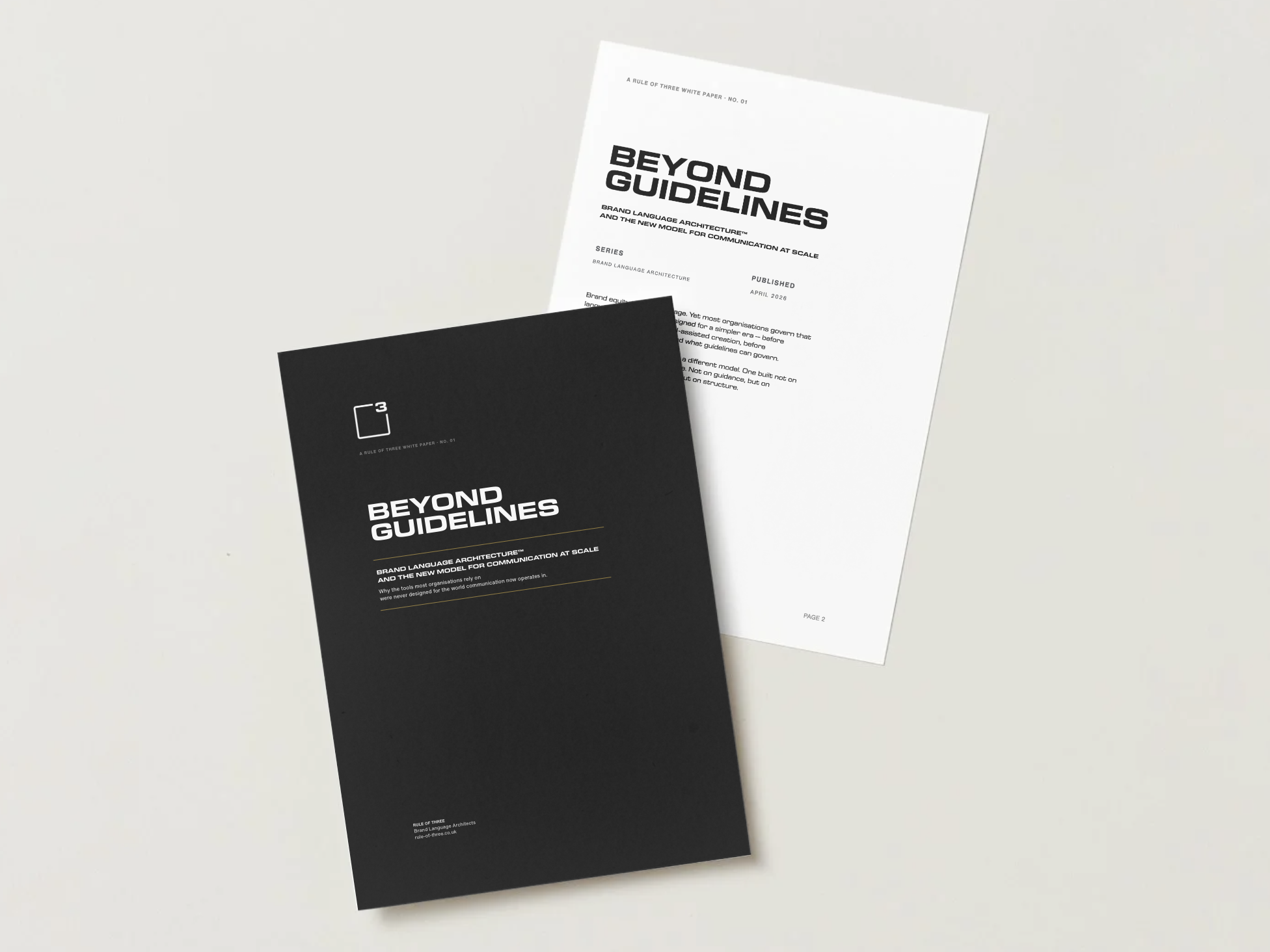
Download White Paper No. 01: Beyond Guidelines
WHITE PAPER NO. 01: BEYOND GUIDELINES.Brand equity lives in language. Yet most organisations govern that language through tools designed for a simpler era.
FURTHER READINGExplore the FAQ – the core definitions of Brand Language Architecture™.
LET’S TALKThis is the work we’ve been designing for — systems that give organisations the structure to communicate with clarity in the age of intelligent communication.
Interested in exploring these ideas further?
