
Most of what a brand calls governance is correction: work is produced, then checked and fixed. The distinction between correcting after and governing before is now the difference between a brand that holds and one that does not.
CORRECTION WAS THE MODELFor as long as brands have existed, staying on brand has been a correction process. Guidelines exist so that work can be checked against them. Reviewers exist to catch what slips. The newer brand-voice tools are correction engines by another name, reading output and flagging what went wrong. This was never a flaw. When people wrote at human speed, correcting on the way out worked, and worked well. The gap between what a brand should sound like and what it did sound like was small, and there was time to close it before anything was published.
THE WRITING OUTRAN THE READINGThe condition that made correction viable was time – enough of it to read and fix before publication. Generative tools removed that time. Content is now produced across every channel and team, by people and by tools, faster than any reviewer can read and far faster than any reviewer can fix. Correction is a rate-limited process set against an unlimited one. Every catch after the fact is a catch too late, and the misses accumulate faster than the corrections land.
MORE HANDS, NOT ONLY MORE VOLUMEThe pressure is not only a matter of volume. The writing has been opened to people who were never writers – a product owner, a marketing team, anyone with a prompt – each generating from their own impression of the brand. A correction layer now has to catch not only more output, but more variation in it, produced by people who cannot always tell when the output has drifted. The layer meant to hold the brand together is being asked to do more precisely as its capacity to do it falls away.
ADDING CAPACITY DOES NOT CLOSE ITThe instinct is to strengthen the correction layer – more reviewers, better tools, tighter process. It does not close the gap, because the gap is not a shortage of correction. A brand can add every reviewer it can afford and deploy every tool available and still lose ground, because correction applied after the writing can only ever reach a fraction of what the writing now produces. The problem is structural, and structure is not solved by more of the thing that was already failing.
MOVE GOVERNANCE TO THE FRONTThe brands that hold together under this pressure made a structural change rather than a greater effort. They moved governance to the front. Instead of checking the writing after it happens, the defined brand is present at the point of creation, built into the tools and the environment where content is made, so the work is drawn from the brand as its source. The output begins on brand, because the brand was there before the first word. Correction becomes the exception rather than the entire system.
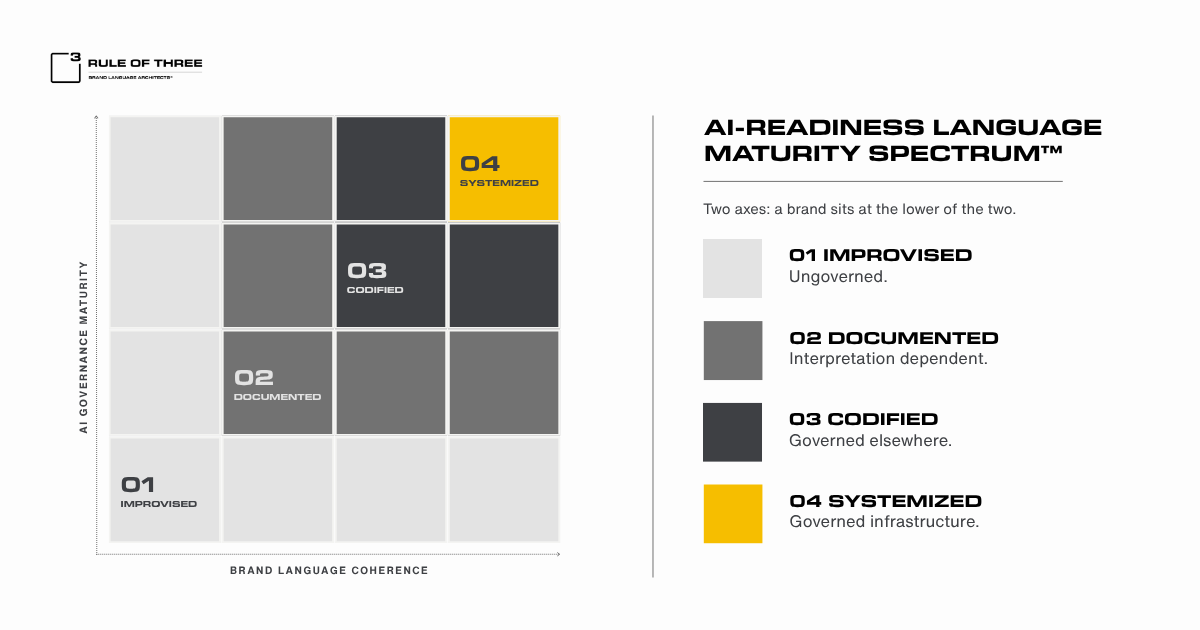
SEQUENCE, NOT EFFORTWhat separates the brands that hold from those that do not comes down to sequence – whether the brand shows up before the writing or after it. Every state below the top applies the brand late: by a person, by a tool, by review. The top state applies it first. That single difference in ordering determines whether a brand survives its own volume, and it is why more effort inside the old model cannot substitute for the change in sequence.
WHAT GOVERNING FIRST REQUIRESGoverning before generation requires a defined brand that can be present at the point of creation – not a document to be consulted, but a source encoded into the tools where content is made. This is why the change cannot be bought as software alone. A tool needs something to apply, and where the brand has not been defined in an ownable, portable form, the tool supplies its own. The move to govern first is therefore a move to define and own the source, and to place it where the writing happens.
WHERE A BRAND GOVERNSWhether a brand governs before or after the writing is largely a function of the state it is in, and most organizations govern later than they believe. The AI-Readiness Language Maturity Spectrum exists to establish where a brand sits, and by extension when its governance takes effect. The move from correcting after to governing before begins with knowing which of the two a brand is currently doing.
HOW MATURE IS YOUR BRAND?The AI-Readiness Language Maturity Spectrum™ – nine questions, about four minutes, and the level you are actually on.
FURTHER READINGExplore the FAQ – the core definitions of Brand Language Architecture™.
LET'S TALKThis is the work we've been designing for – systems that give organisations the structure to communicate with clarity in the age of intelligent communication.
Interested in exploring these ideas further?
