THE SPECTRUM: 04. THE SYSTEMIZED BRAND

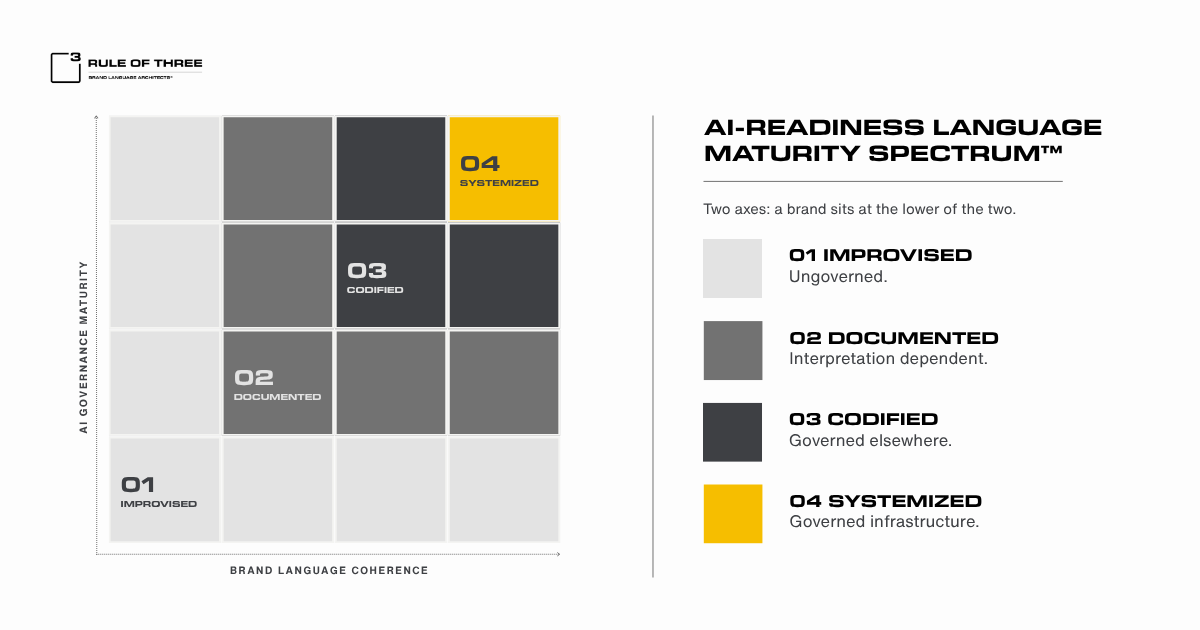
The fourth state is rare, and it is the only one where producing more language makes the brand stronger. What separates it from the rest is timing: governance operates before the writing rather than after it.
SCALE AS A LIABILITYFor a brand in any of the lower three states, volume works against it. Every additional piece of content is another opportunity for drift – more surface, more hands, more interpretations of a brand that was described rather than defined. Each drift is small and invisible in isolation. Across ten thousand outputs it stops reading as small errors and starts reading as a brand that has lost its edges. Scale, for an ungoverned brand, is a slow tax on distinctiveness, paid continuously and rarely noticed until the distinctiveness is gone.
THE VOLUME IS NOT OPTIONALThat tax would matter less if the volume were containable. It is not. Content output rises every year, across every channel and team, and AI has multiplied it further by opening the act of writing to people who were never writers. The volume is arriving whether or not a brand is ready for it. For most organizations, that means the liability compounds on its own – more content drawn from a brand that cannot govern it, produced faster than anyone can feel the drift accumulate.
EFFORT DOES NOT SCALEThe lower states hold the line by effort. Capable people write well, reviewers correct what drifts, tools flag what slips. Effort of this kind worked when writing was slow and human. It cannot keep pace with machine-scale production, because correction is a limited process set against an unlimited one. An organization can add reviewers and buy tools and still lose ground, because the gap is not a shortage of effort. It is that effort applied after the writing can never catch all of what the writing now produces.
RARE, AND NOT BY ACCIDENTThe fourth state is reached by a structural change, not by working harder within the lower states or by acquiring better tools to apply to an undefined brand. Most organizations have not made that change, because until machines began writing at volume, they did not need to. Very few brands occupy the state, and fewer still that believe they do. The rarity is the point. The conditions that now reward it are recent, and most brands are still equipped for the world that preceded them.
GOVERNED AT THE SOURCEA systemized brand holds its language as a defined system it owns, encoded into the environments where content is made and portable across the tools it uses to make it. The definition is present at the point of creation, so the work is drawn from the brand as its source rather than corrected toward it afterward. Oversight is continuous rather than occasional, because the system is wherever the work happens. Governance stops being a filter applied at the end and becomes the condition the writing begins from.
VOLUME CHANGES DIRECTIONBecause every output is generated from the same owned source, more content means more of the brand, expressed consistently, everywhere at once. The volume that erodes an ungoverned brand strengthens a governed one, by the same mechanism running in the opposite direction. The widening of who can write follows the same inversion: a product owner or a marketing team generating from the system produces on-brand work by default, because the brand is present in the tool rather than in their training. Scale becomes an asset the moment the brand governs the source it is drawn from.
BUILT, NOT STUMBLED INTOThe systemized state is the output of a discipline, not an accident of scale or a matter of unusual effort. What often looks like exceptional consistency is exceptional infrastructure – the brand's language built once, precisely, and placed where the work happens. Brand Language Architecture is the discipline concerned with that infrastructure: designing the system behind a brand's communication rather than the communication itself. The state is reached deliberately, by treating language as something to be structured and owned, and it holds because governance is built into where the producing happens rather than applied to it after.
THE POSITION WORTH REACHINGThe fourth state is the one current conditions reward, and the one most brands assume they are closer to than they are. The distance between the felt position and the real one is what the AI-Readiness Language Maturity Spectrum exists to establish. Reaching the systemized state begins with an accurate reading of the state a brand is in, and the honest read is where the work starts.
HOW MATURE IS YOUR BRAND?The AI-Readiness Language Maturity Spectrum™ – nine questions, about four minutes, and the level you are actually on.
FURTHER READINGExplore the FAQ – the core definitions of Brand Language Architecture™.
LET'S TALKThis is the work we've been designing for – systems that give organisations the structure to communicate with clarity in the age of intelligent communication.
Interested in exploring these ideas further?
