BRAND LANGUAGE EXISTS IN ONE OF FOUR STATES

Brand language occupies one of four states. The distance between them is structural, not stylistic. Most organisations assume they sit higher than they do, and the assumption is the first thing worth examining.
THE UNGOVERNED STATEIn the first state, brand language is Improvised. It lives in memory and instinct, with nothing written down that anyone could reliably work from. Coherence is accidental, dependent on whoever happens to be writing at the time. AI has made this state acute rather than incidental. Intelligent tools now produce language in the brand's name, prompted from whatever each person believes the brand to be on a given day. In effect, every writer becomes the brand's author, and the brand is composed continuously by people who were never asked to define it. This is the ungoverned condition, and it is more common than most organisations would accept.
A DOCUMENT READS AS GOVERNANCE WHILE DOING NONE OF THE LOAD-BEARING WORK AN INTELLIGENT SYSTEM REQUIRES.
THE DOCUMENTED TRAPThe second state is Documented. Guidance exists: a tone-of-voice document, principles, a set of examples. People read it, interpret it, and interpret it differently. Coherence holds where experienced people are involved and thins everywhere else. Given the same document, an AI tool compresses it to a rough summary and works from that. The brand is described rather than defined. This is where most large organisations sit, and it is the state most easily mistaken for maturity. A document reads as governance while doing none of the load-bearing work an intelligent system requires, because a document must be read, interpreted and remembered, and none of those hold at machine speed. Describing a brand and defining it are separate acts.
GOVERNED ELSEWHEREThe third state is Codified. Language is defined precisely enough to be acted on – a lexicon, structures, rules for how the voice adapts. Drift slows. What remains unresolved is the layer that applies the definition. Either experienced people apply it by review, which cannot hold at machine speed, or a platform infers its own model of the brand and enforces from within infrastructure the organisation does not own. The governance is real. It is also episodic, or held somewhere other than in the brand's hands. A brand can be precisely defined and still not own the thing enforcing it, which raises a sharper question than how well the language is written.
TWO MEASURES, NOT ONEUnderneath the four states sits a question that reorders where a brand believes it stands. Coherence and governance are two separate measures, and a brand is only as ready as its weaker one. A precisely defined language, run through ungoverned tools, sits lower than the definition alone would suggest. This is why the honest position usually sits a level below the confident one. The test that cuts cleanest concerns ownership: if the brand changed AI platform tomorrow, would its definition travel with it? If the definition would have to be rebuilt inside the new environment, the brand has found the state it actually occupies, rather than the one it assumed.
WHAT MATTERS IS NOT ONLY HOW WELL THE LANGUAGE IS DEFINED, BUT WHO HOLDS THE LAYER THAT APPLIES IT – AND WHETHER THAT LAYER TRAVELS.
GOVERNED INFRASTRUCTUREThe fourth state reframes the others. In the Systemized state, the definition is encoded where content is made, owned by the brand, and portable across the tools used to produce it. Governance is continuous and auditable rather than episodic. Volume compounds the brand rather than drawing it down. Very few brands are genuinely here. Seen from this state, the earlier question resolves: what matters is not only how well the language is defined, but who holds the layer that applies it and whether that layer travels. Coherence and governance stop being two separate exposures and become one owned system. This is the state the Rule of Three Language System® is built to produce, and the state Arcroyd™ embeds.
A PRECEDENT ALREADY SETNone of this is a judgement. Every one of these states is a reasonable place to have arrived. Most brands built the visual design system first and simply never gave brand language the same treatment. The design system gave the visual brand governed consistency – a defined structure that holds the look together across teams, markets and tools while leaving room to create. Language never received the equivalent. The Systemized state is that equivalent, applied to language: the same discipline the design system brought to the visual brand, now governing how a brand sounds. What has changed is that the state a brand occupies can now be seen, and seeing it is difficult to undo.
AI IS WRITING THE BRAND TODAY, AT WHICHEVER STATE IT OCCUPIES, GOVERNED OR NOT.
THE STATE WILL NOT HOLD STILLThe position will not hold still. AI is writing the brand today, at whichever state it occupies, governed or not. The state a brand stands in is already shaping how that turns out, whether it has been named or not. This is why naming it is the first structural act rather than a diagnostic afterthought. Clarity here does not come from writing better rules or refining the guidance further. It comes from seeing, plainly, which of the four states the language actually operates in, and understanding that coherence and governance are measured separately. Once the state is named, the work of moving between states becomes a decision the organisation can own rather than a drift it absorbs.
NAMING THE STATEA brand can establish its indicative position against these four states in a few minutes. The AI-Readiness Language Maturity Spectrum™ sets out the two measures – brand language coherence and AI governance maturity – and returns the state a brand currently occupies, taking the lower of the two. It is an indicative reading rather than a formal classification; the AI-Readiness Brand Language Audit™ establishes that formally. Neither changes the state a brand is in. Both make it visible. The honest look begins with seeing which state the language operates in today, and deciding, deliberately, whether that is the state it should remain in.
HOW MATURE IS YOUR BRAND?The AI-Readiness Language Maturity Spectrum™ – nine questions, about four minutes, and the level you are actually on.
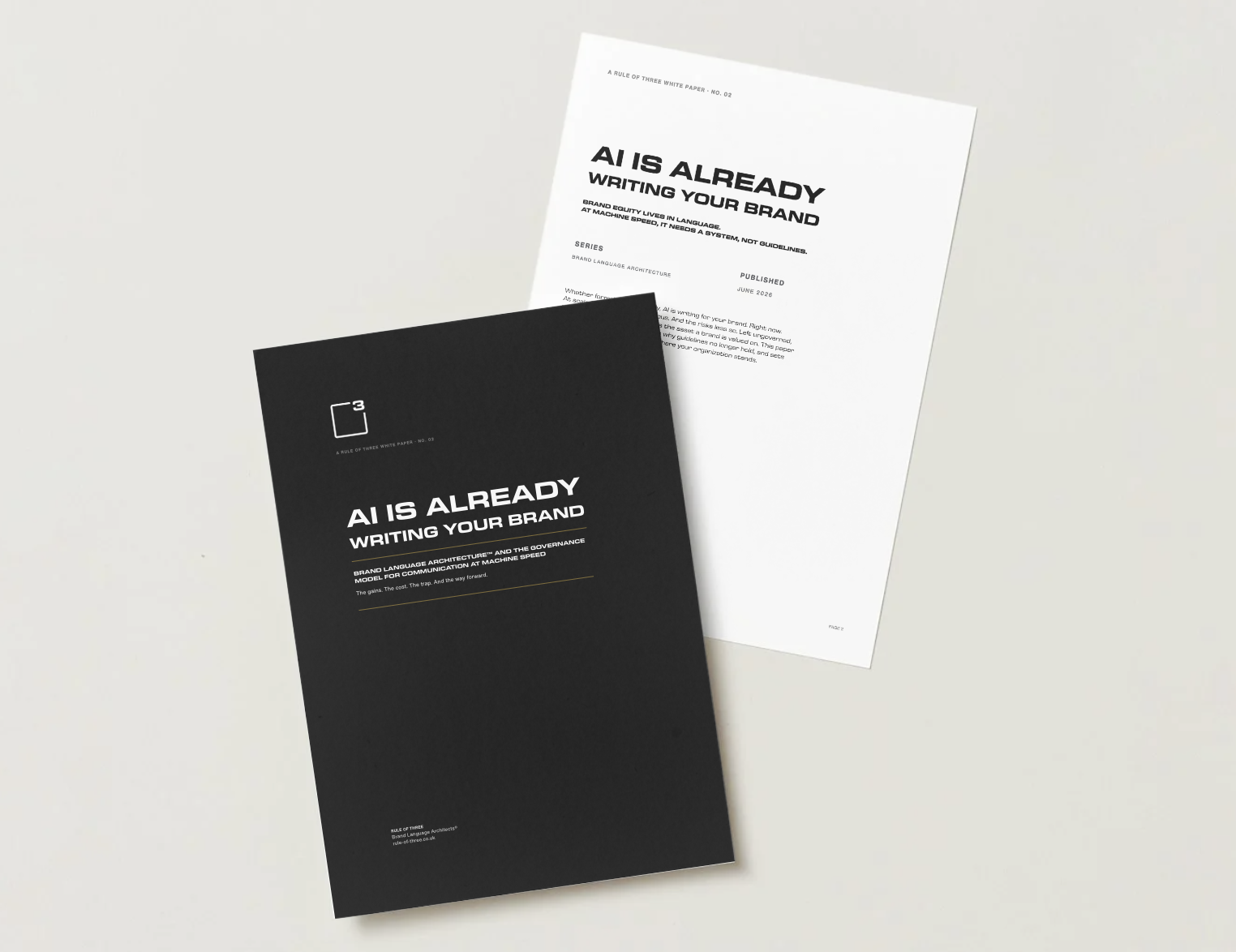
Download the white paper: AI Is Already Writing Your Brand
WHITE PAPER NO. 02: AI IS ALREADY WRITING YOUR BRAND Whether formally or informally, AI is writing for your brand today, at scale. This paper examines the exposure, explains why guidelines no longer hold, and sets out the structured way to see where your organization stands.
FURTHER READINGExplore the FAQ – the core definitions of Brand Language Architecture™.
LET'S TALKThis is the work we've been designing for – systems that give organisations the structure to communicate with clarity in the age of intelligent communication.
Interested in exploring these ideas further?
