YOUR BRAND HAS A DESIGN SYSTEM. NOW IT'S TIME TO GIVE IT A LANGUAGE SYSTEM.

The visual brand stopped being a few rules in a document long ago and became a system, defined and owned. The brand's language never received the same treatment, and at machine speed that gap shows.
GENERIC BY DEFAULTAI now writes the brand throughout the day, and left alone the language drifts toward the generic. This is the models doing exactly what they are built to do. Trained on the whole internet to sound like everyone, their natural output is the average of everything, and unchecked, that average is what a brand starts to sound like. The drift is the tools' default behaviour, applied at scale to a brand that gave them nothing more specific to work from.
“THEIR NATURAL OUTPUT IS THE AVERAGE OF EVERYTHING, AND UNCHECKED, THAT IS WHAT A BRAND STARTS TO SOUND LIKE.”AN INSTINCT THAT CANNOT TRANSFERAI also opened content creation to everyone, a gift and a problem at once. Much of the brand is now written by people never trained to hear when it has slipped. The instinct that once caught that drift lived in a few experienced heads, and it cannot be handed to a machine. A person can hold a brand without ever writing it down. A model can only work from what it can read, and most brands have given it very little.
"A PERSON CAN HOLD A BRAND WITHOUT EVER WRITING IT DOWN. A MODEL CAN ONLY WORK FROM WHAT IT CAN READ."THE LAYER ABOVE THE PROBLEMA growing category of software promises to keep AI content on brand. Adobe's Brand Intelligence and Brivvy are two of the names, with more arriving every month. They are genuinely useful, and they all work on the layer above the problem: they apply and police a brand, when the harder question sits underneath. What, exactly, are they applying?
OWNED BY SOMEONE ELSEFor most organizations the answer is brand guidelines, never defined deeply enough for a system to act on. The more capable tools offer to solve that by inferring the brand from existing content and building their own model of it, which then lives inside their platform, owned by them. The brand's equity ends up locked into someone else's infrastructure, and not necessarily theirs to take when they leave.
A DISCIPLINE OF ITS OWNClosing that gap is a discipline in its own right: giving a brand's language the same forensic, systematic treatment the visual side has had for years, so that it exists as a system the organization owns rather than a document people interpret. At Rule of Three this discipline is called Brand Language Architecture™. What it produces is a Brand Language System.
WHAT THE SYSTEM HOLDSA Brand Language System captures a brand's language in full. It sets down what the brand means and the knowledge it draws on, its style and tone, and how it adapts across audiences and channels. It defines its content structures and the governance that decides what stays on brand and what has slipped. Defined that precisely, it can be encoded into the AI tools the organization already uses. It is the layer the enforcement tools assumed was there. Once it exists, they finally have something real to govern.
WHEN VOLUME REVERSESSomething underestimated changes once the system is in place. Every piece of content was always either adding to the brand or drawing it down; ungoverned, most of the volume was a quiet withdrawal. Governed, that same volume reverses. Each piece generates from the brand itself, so the quantity that eroded the asset begins to build it. The speed the organization wanted and the brand it meant to protect stop pulling against each other, and the meaning sits in something it owns, carried across whatever tools come next.
"THE QUANTITY THAT ERODED THE ASSET BEGINS TO BUILD IT."WHERE IT BEGINSThe first step is an honest account of where the brand's language stands today: how clearly it is defined, how consistently it holds, how AI is really being used, and where that leaves the organization as the rules tighten. Rule of Three runs this as the AI-Readiness Brand Language Audit™. The decision cannot really be postponed. AI is writing the brand today, governed or not, and leaving the language ungoverned is itself a decision, made a little more each day by tools working from their own impression of the brand.
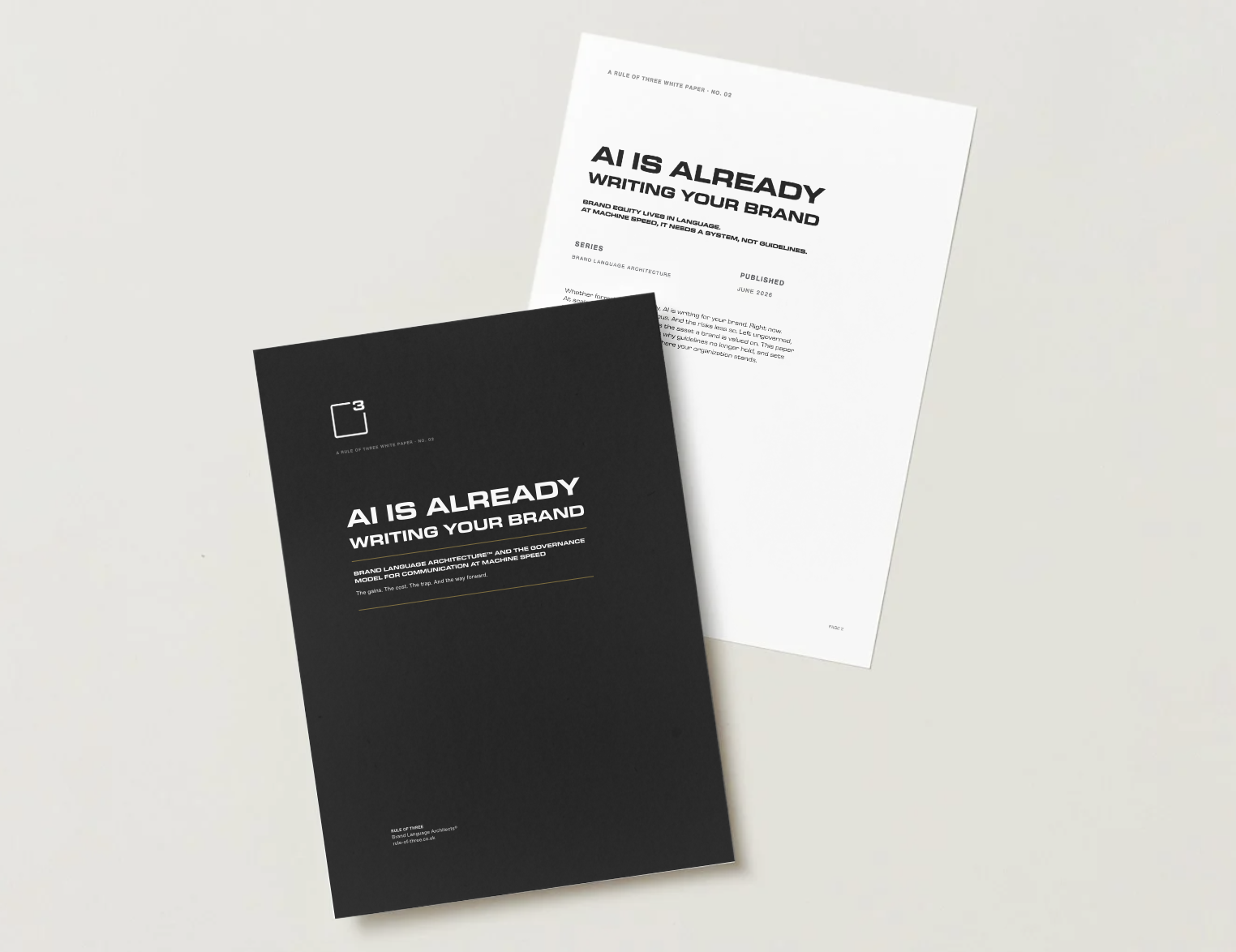
Download the white paper: AI Is Already Writing Your Brand
WHITE PAPER NO. 02: AI IS ALREADY WRITING YOUR BRAND Whether formally or informally, AI is writing for your brand today, at scale. This paper examines the exposure, explains why guidelines no longer hold, and sets out the structured way to see where your organization stands.
FURTHER READINGExplore the FAQ – the core definitions of Brand Language Architecture™.
LET'S TALKThis is the work we've been designing for – systems that give organisations the structure to communicate with clarity in the age of intelligent communication.
Interested in exploring these ideas further?
