THE AI HYPE CYCLE IS ALREADY OUTDATED

For the past year, the creative and communication industry has been caught in a familiar loop: the belief that AI is transforming writing. The transformation is real, but the framing is already out of date.
“AI DID NOT CHANGE HOW WRITING WORKS. IT REVEALED HOW UNSTABLE THE UNDERLYING COMMUNICATION ENVIRONMENT WAS ALREADY BECOMING.”
THE WRITING REVOLUTION FRAMINGMost commentary positions AI as a breakthrough in craft. AI writes faster. AI produces at lower cost. AI matches tone with reasonable fluency. AI accelerates the throughput of communication teams. Each observation is technically accurate.
The framing it produces, though, is strategically incomplete. The industry has treated AI as a writing tool, when its more significant effect operates one level down. The disruption is not at the level of words. It is at the level of the environment that words are produced inside.
What has actually shifted is the visibility of the structures that govern brand communication. AI did not change how writing works. It revealed how unstable the underlying communication environment was already becoming.
A STRUCTURAL EXPOSURETone guides, messaging decks, voice charts, editorial rules and brand books were built for a particular operating environment. A small number of specialists created the majority of content. Review cycles were slower. Teams worked from shared context. Scale was predictable. Language changed by the month rather than by the minute.
AI entered this environment and accelerated every dimension at once: creation, interpretation, distribution, drift and the rate at which inconsistency compounds. The conditions the older tools were designed for no longer exist.
The result is the surfacing of a structural weakness that has been quietly present for years. AI did not break organisational communication. It removed the conditions in which the existing fragility could continue to absorb the strain.
“IN ENVIRONMENTS WITHOUT DEFINED ARCHITECTURE, AI AMPLIFIES DRIFT. IN ENVIRONMENTS WITH DEFINED ARCHITECTURE, AI ACCELERATES CLARITY. THE STRUCTURE SURROUNDING THEM IS WHAT DETERMINES THE RESULT.”
THE LIMITS OF TOOL-FIRST RESPONSESThe industry has responded at the surface level. More tools, more prompts, more AI writing workshops, more tone grids, more governance documents. Each response is well-intentioned. Each addresses a symptom rather than the underlying condition.
A writing tool cannot resolve structural fragmentation. A tone guide cannot govern multi-channel, multi-team, AI-accelerated creation. A messaging deck cannot align hundreds of daily language decisions across regions, functions and interfaces operating at different speeds.
The same pattern now appears across organisations with consistency. In environments without defined architecture, AI amplifies drift. In environments with defined architecture, AI accelerates clarity. The model and the prompts are often identical. The structure surrounding them is what determines the result.
CRAFT, MEANING AND THE SHIFT IN FOCUSThe real transformation underway is not a transformation of writing. It is a transformation of how meaning is governed across the systems that produce writing.
The relevant question has moved from "how do teams write with AI" to how meaning flows through a system when people and intelligent tools create together. That question cannot be answered at the level of craft alone. It requires a defined architecture: how tone behaves across contexts, how messaging scales across markets, how boundaries are enforced, how AI is permitted to operate, how teams interpret meaning, how workflows preserve coherence, how governance protects integrity, and how the brand evolves as the environment shifts.
A Brand Language System addresses this layer directly. It operates as infrastructure rather than as guidance.
“CLARITY THAT DEPENDS ON INDIVIDUAL MEMORY CANNOT HOLD THESE CONDITIONS FOR LONG. WHAT IS REQUIRED NOW IS A SYSTEM IN WHICH CLARITY IS DESIGNED INTO THE ENVIRONMENT ITSELF.”
WHY CLARITY CAN NO LONGER RELY ON MEMORYFor years, organisations operated as though clarity was something individuals remembered. Write like this. Avoid that. Consult the guideline when in doubt. The model worked because the operating tempo allowed it to.
That tempo no longer exists. Modern communication moves at machine speed across distributed teams, diverse channels, shifting contexts and interfaces that constrain expression in ways no document anticipates. Clarity that depends on individual memory cannot hold these conditions for long.
What is required now is a system in which clarity is designed into the environment itself. Embedded into workflows, tools and intelligent systems, so that coherent expression becomes the default behaviour rather than an outcome of sustained personal vigilance. AI has not made structure useful. It has made structure necessary.
THE DISCIPLINE THE INDUSTRY HAS BEEN CIRCLINGThe work this requires sits across writing, brand, operations, governance, UX and AI enablement, but is not contained by any of them. It is a unified discipline addressing how meaning is structured, governed and operationalised across communication.
Brand Communication System Design is the discipline that addresses this directly. Inside it, clarity is engineered, tone is governed, meaning is architected, AI operates within defined boundaries, and the structural conditions for consistent expression are built into the environment in which communication happens.
This is where the next phase of the conversation now sits. The transformation is no longer of writing. It is of the architecture that determines how a brand thinks, speaks and creates across people, tools and intelligent systems.
THE WORK AHEADThe AI writing debate will continue for some time. Hype cycles always do. The more consequential question for organisations is whether the structure underneath their communication is genuinely defined, or only described.
This is the work of Brand Language Architecture: designing the system that determines how language operates inside an organisation, so that human creators and intelligent tools produce coherent output by default rather than by exception. The organisations that build this architecture now will treat language as infrastructure rather than as output, and the resulting coherence will scale with the system rather than with individual effort.
In the age of intelligent communication, clarity has become a structural property of the environments that produce it.
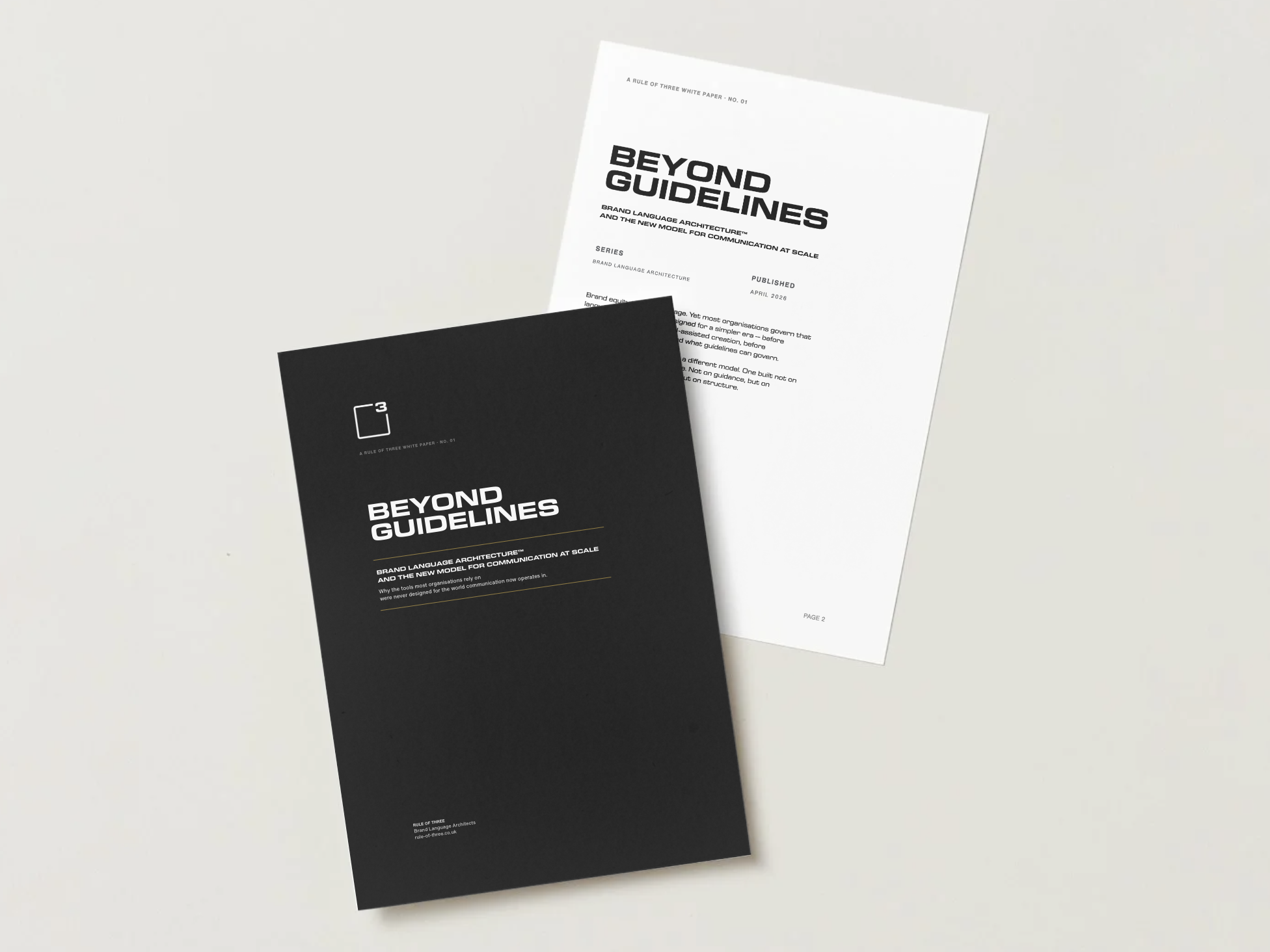
Download the white paper: Beyond Guidelines
WHITE PAPER NO. 01: BEYOND GUIDELINES.Brand equity lives in language. Yet most organisations govern that language through tools designed for a simpler era.
FURTHER READINGExplore the FAQ – the core definitions of Brand Language Architecture™.
LET’S TALKThis is the work we’ve been designing for – systems that give organisations the structure to communicate with clarity in the age of intelligent communication.
