Most lists of tone of voice examples tell you what a brand sounds like. Playful. Bold. Friendly. That's the easy part, and it's rarely useful on its own.
The more useful question is how. What does the brand do with its words, sentence by sentence? Where does it stop? And what would still work if you borrowed it for a brand of your own?
How to read these examples
The twelve brands below are grouped by where they sit on two of the dials that set a tone: how serious or playful they are, and how reserved or warm. For each, there's a short note on how it sounds, what it does on the page and the one thing worth taking from it.
None of them is a template. A tone works because it fits the brand that owns it. What travels between brands is the craft underneath: the choices, and the limits.



Irreverent: Liquid Death, Wendy's, Ryanair
Liquid Death.
Deadpan, heavy metal and completely committed.
Liquid Death sells canned mountain water and writes about it the way a horror film or a metal band would, starting with its line "Murder your thirst." It has even turned its online hate comments into metal albums. The joke never wavers, and it carries a serious point: the brand's campaign against plastic.
Worth borrowing:commit completely, and let the joke carry something you mean.
Wendy's.
Quick, cheeky and competitive.
Wendy's built a social media persona that roasts rivals and, when invited, its own followers. The brand describes the aim as a challenger with charm, one that roasts with a wink, and a small social team is trusted to reply fast.
Worth borrowing:a persona with one clear rule (here, the wink) is what lets a team move quickly without going too far.
Ryanair.
Blunt and self-mocking.
Since 2020, Ryanair's TikTok has put a cartoon face on one of its planes and used it to joke about everything passengers complain about: fees, no-frills seats, distant airports. When the person who built the account moved on, the tone carried on without them.
Worth borrowing:say what people already say about you, before they do, and make the voice a system so it doesn't leave with one person.
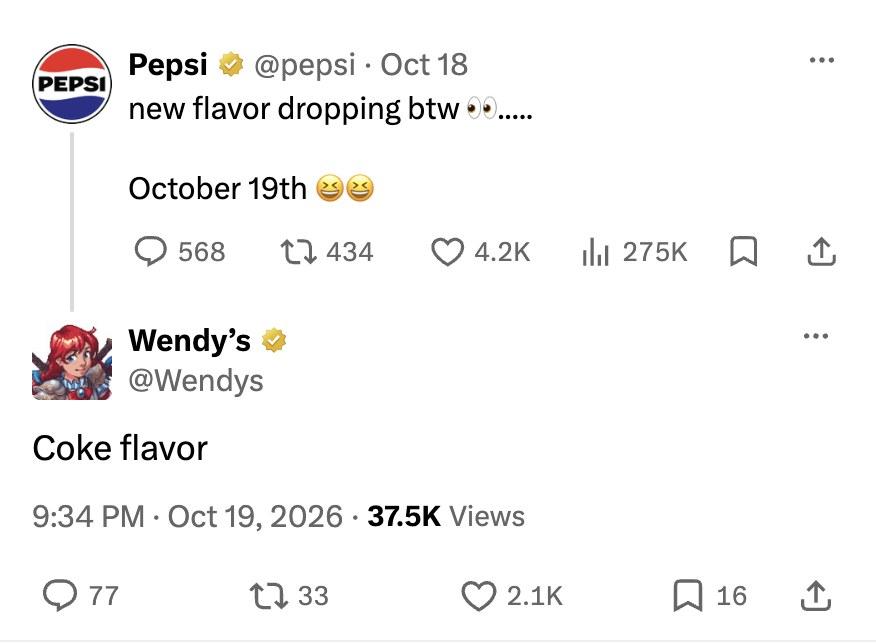
Wendy's, replying to Pepsi on X, 19 October 2026  “If you don't like it, buy your own plane”Ryanair · TikTok
Playful, with limits: Duolingo, Spotify, Old Spice
Duolingo.
Chaotic on social, kind in the app.
Duo, the green owl, is famously unhinged on TikTok, where the account grew from about 50,000 followers to 16 million in a little over four years. Inside the app, the same owl is encouraging, and the company's press office doesn't do unhinged at all.
Worth borrowing:one character can carry several registers, as long as each channel knows which one it's in.
Spotify.
Warm, nosy and precise.
Every year since 2016, Wrapped has turned listening data into billboards that read like affectionate gossip, such as "Dear person who played Sorry 42 times on Valentine's Day."
Worth borrowing:a specific detail is funnier and warmer than any adjective.
Old Spice.
Absurd confidence, tightly written.
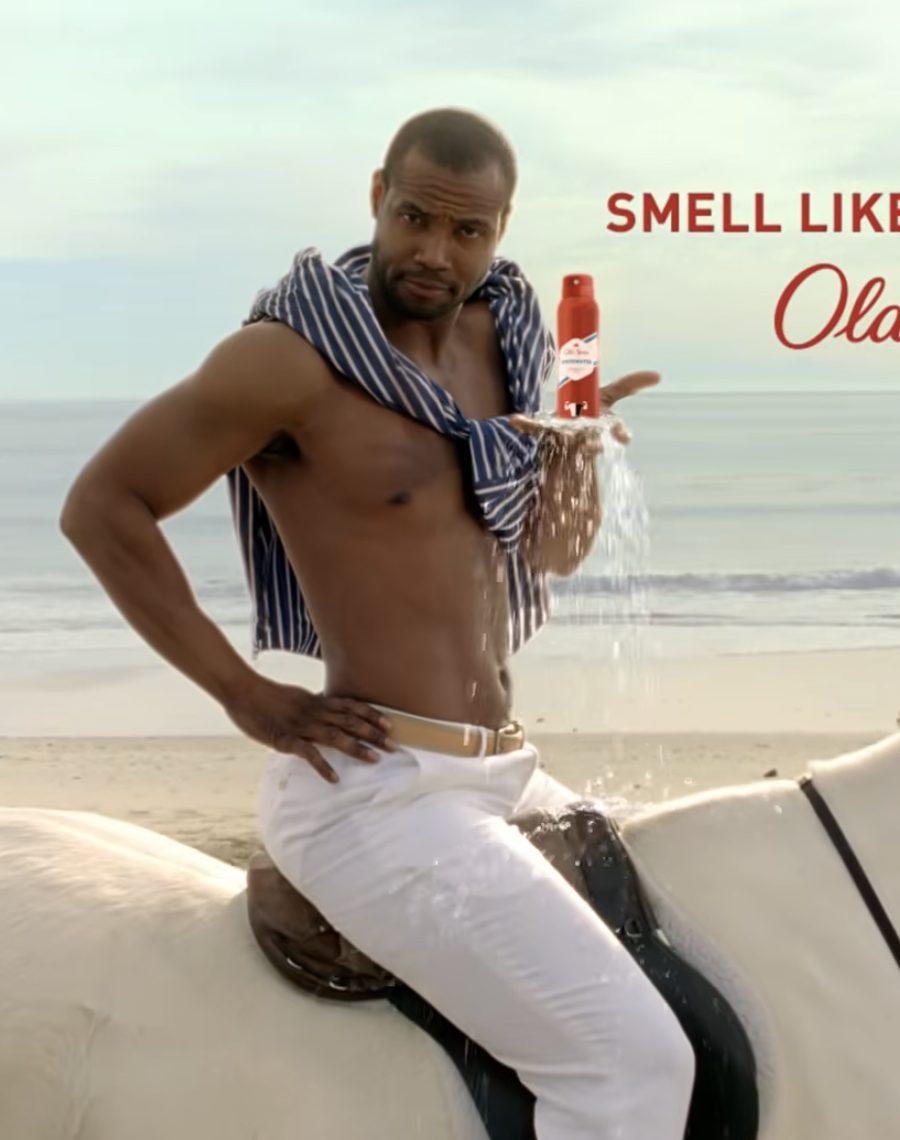
In 2010, "The Man Your Man Could Smell Like" used a rapid-fire monologue to rebuild an old brand in 30 seconds. By May that year, sales of the advertised body wash were up 60% on the year before.
Worth borrowing:absurdity only works when every line is precise.

Plain and useful: Wise, IKEA, Slack
Wise.
Direct and transparent.
Wise's whole proposition is that you can see what you pay, and its writing does the same: "No asterisks. No small print. No hidden fees." The plainness is the product.
Worth borrowing:when the promise is honesty, every sentence has to keep it.
IKEA.
Simple, friendly and a little familiar.
IKEA has always aimed to be simple and straightforward with customers, and its own museum sums up the culture as one big "Hej!" It keeps one identity worldwide, playful, inclusive and simple, while leaving room for each country to adapt it.
Worth borrowing:a voice simple enough to travel, with room for local accents.
Slack.
Clear, concise and human.
Slack describes its voice in those three words and puts small moments of warmth into the product: a loading message might just say "You look nice today." When something goes wrong, the jokes stop and error messages lead with empathy.
Worth borrowing:personality in the small, low-stakes places, plain help in the hard ones.
Calm and considered: Headspace, Aesop, M&S Food
Headspace.
Calm, kind and approachable.
Headspace's guidelines treat tone as part of the same system as its illustration and motion, so the whole experience feels calm. As the brand widened from meditation into coaching and care, its identity was asked to feel kind and warm.
Worth borrowing:let the tone do what the product does for people.
Aesop.
Literary and restrained.
Aesop says little about itself and almost nothing that sounds like beauty advertising. Its packaging carries quotations from writers such as Proust and Faulkner, and it has published its own literary digest.
Worth borrowing:restraint and reference can say more about a brand than any claim.
M&S Food.
Slow, sensory and indulgent.
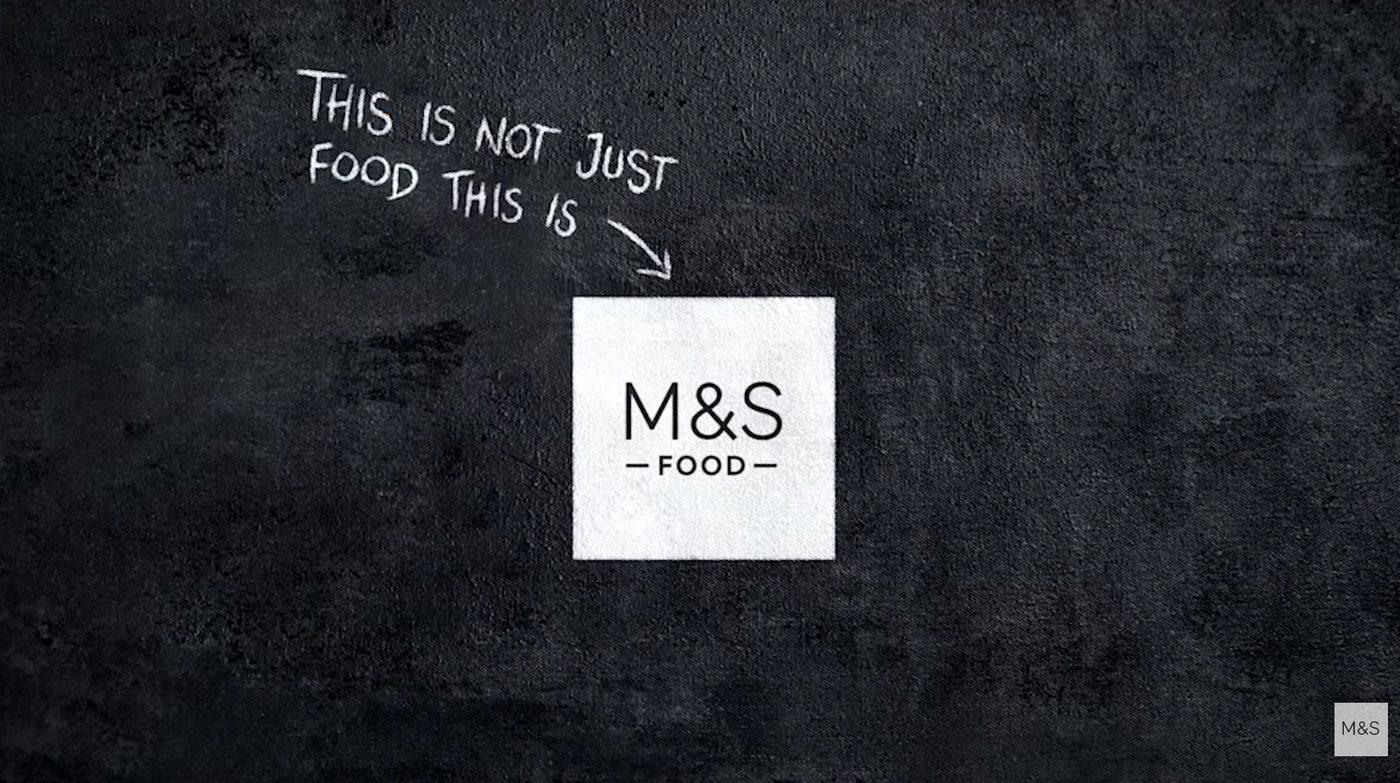
From 2004, "This is not just food, this is M&S Food" paired slow-motion close-ups with a lingering voiceover, and the line became so familiar it was parodied everywhere. M&S brought it back in 2019.
Worth borrowing:a line built well enough can return years later and still belong to you.
What the strongest examples share
Twelve brands, twelve different sounds, and the same few things underneath.
The tone grows out of something true. Wise is plain because transparency is its product. Liquid Death's jokes serve its stand on plastic. A tone that isn't rooted in the business sounds like a costume.
There are limits, and people know them. Wendy's roasts with a wink. Duolingo's press office stays straight. Slack drops the jokes when something breaks. The limits are what make the personality safe to use.
It holds beyond one person. Ryanair's tone survived the departure of the person who built it. That only happens when the voice is written down well enough for others to carry.
Specific beats clever. Spotify's numbers, M&S's close-ups and Old Spice's precise absurdity all work because of the detail.
Finding your own tone of voice
It's tempting to point at one of these brands and say "like that." It rarely works, because the tone belongs to a business that isn't yours. Borrow the craft instead:
Start from what's true about your brand: what it believes, and what it does that others don't.
Set the dials. Decide how playful, how warm and how formal you are by default, and how far each can move. Voice and tone covers the dials in detail.
Write the limits down. Say where humour stops and what you'd never say.
Test it in hard moments. A complaint, an outage, a refund. If the tone holds there, it will hold anywhere.
Our guide to tone of voice walks through defining one from the start.
When AI writes in your tone
Ask an AI tool to write like Liquid Death and you'll get skulls, puns about murder and a lot of capital letters. It picks up the surface quickly. What it misses is everything that makes the tone work: the point the joke carries, where it stops, what the brand would never say.
The same thing happens with your own tone. Given a few adjectives, a model produces something that sounds roughly right and drifts towards the average of your category. Given a full definition, with the limits written down and real examples for each kind of content, it can hold the tone the way a good writer would. That's the difference AI brand guidelines are there to make.
Tone of voice as part of a system
Every brand on this list has a tone strong enough to recognise in a single line. In a Brand Language System, that tone is set down alongside the brand's meaning, vocabulary and every content type it produces, so people and AI can carry it the same way.
That's how a tone stays recognisable across thousands of lines, whoever writes them, including Arcroyd®, the brand's own AI.
Questions about tone of voice examples
The ones people recognise from a single line. Liquid Death, Wise, Duolingo, Aesop and Slack are good examples, each in a very different register. What they share is a tone that grows out of the business and has clear limits.
Most tones can be placed on a few dials: formal to relaxed, serious to playful, reserved to warm and brief to explanatory. A brand's tone is where it sits on each, and how far it can move.
No. A tone works because it fits the brand that owns it. Borrow the craft instead, such as committing fully, setting limits or using specific detail, and apply it to what's true about your own brand.
By defining the tone fully, with its limits and real examples for each kind of content, and giving AI that definition every time it writes. A few adjectives in a prompt produce the surface without the substance.