Most brand guidelines assume a reader who can fill the gaps. A language model is a very different reader.
Hand it the brand guidelines and it will do its best. It turns the document into a working summary of its own, a few adjectives and a handful of rules, and fills everything else from its training: the language of every brand, belonging to none. The logo rules survive the trip well enough. The voice mostly doesn't.
The logo rules survive the trip well enough. The voice mostly doesn't.
Why brand guidelines fall short for AI
Brand guidelines were built to guide people. They rely on judgement: a designer who knows when to break the grid, a copywriter who has absorbed the brand over years and can hear when a line is off.
The visual side of most guidelines is precise. Colours come as values, type as a scale, spacing as a system, so a tool can apply them exactly. The verbal side is usually a page or two: a handful of traits, some words to avoid, a few examples. That was enough while experienced people did the writing.
AI meets the gaps without the judgement. Wherever the guidelines are vague, the model reaches for the most common way of saying it, and the most common way belongs to no one. Piece by piece, the voice drifts towards the middle of the category, which is the one place a brand can't afford to sound like.
What AI brand guidelines need to hold
Guidelines that AI can follow hold the same things a good writer carries in their head, set down precisely enough to be applied:
- What the brand means. Its positioning, its promise and what must stay true, in order of weight, so the model knows what leads and what supports.
- How the voice behaves. The character, defined with examples, and how it flexes between a social post and a board paper. Our tone of voice guide covers what that definition needs.
- The words. The signature vocabulary, the terms that must be used exactly, the words the brand avoids, and the conventions: spelling, punctuation, how the name is written.
- Who decides. Who owns the brand's meaning, what needs approval, and how the guidelines change as the brand does.
- Every content type. How an email, a product page or a report is built, each shown through an annotated example.
The last is the part most guidelines leave out, and the part AI needs most. Nearly everything AI writes for a brand is a specific format, and a format carries rules that no list of adjectives can.
Where AI brand guidelines should live
Many AI tools let a team upload its guidelines, or build a brand voice profile inside the platform. It is quick, and it works up to a point. It also means the brand's definition of itself now lives inside someone else's product. Change tools, and the language stays behind.
AI brand guidelines are worth more as the brand's own asset: held outside any tool, readable by people, applied by AI. One reference that both work from, and that the brand keeps whichever tools it uses.
From guidelines to a Brand Language System
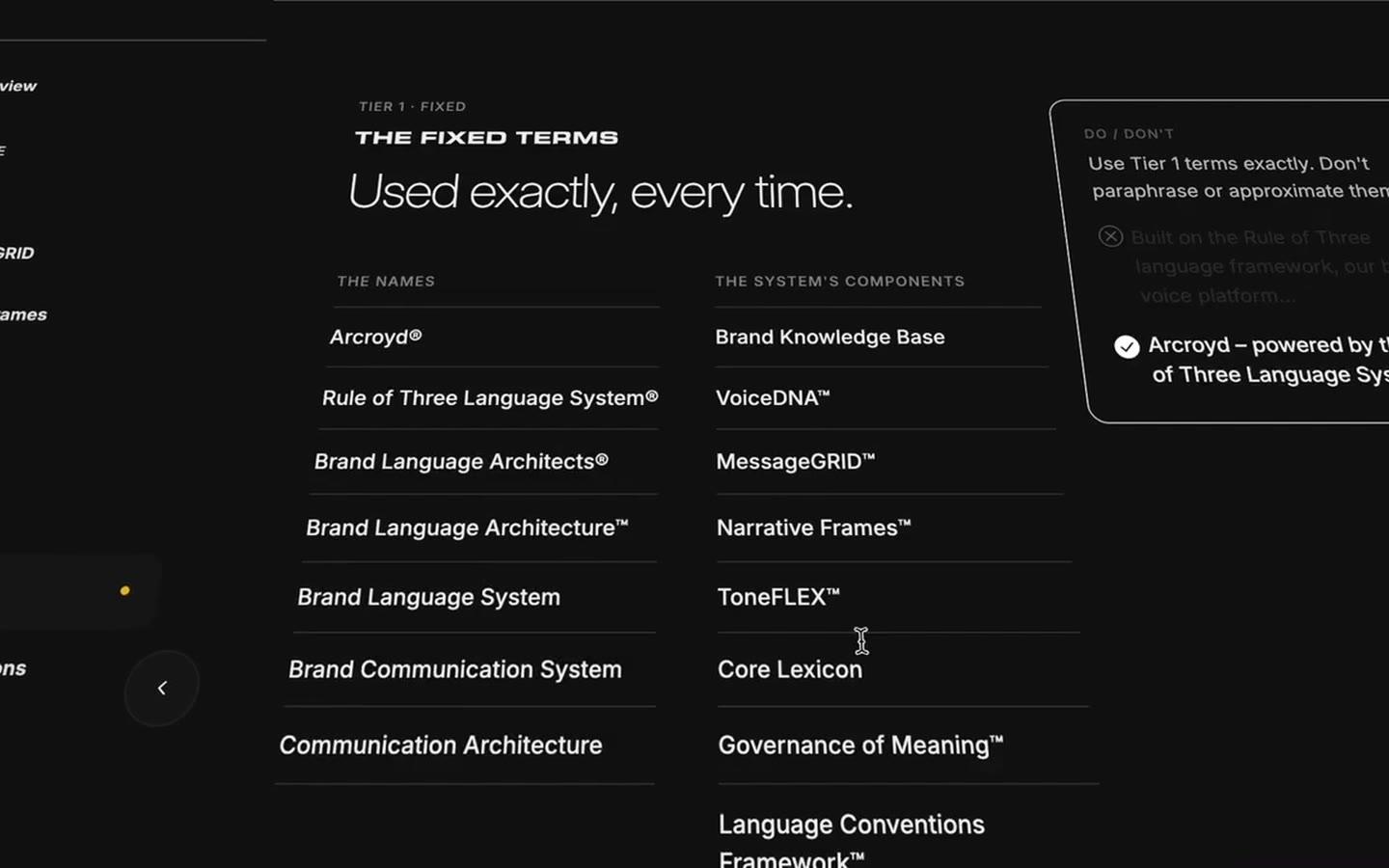
That is what a Brand Language System is: the brand's language, designed in full as one system for people and AI. Its meaning, voice, vocabulary, governance and every content type sit in one place. It's presented as an interactive reference with annotated live examples, and it downloads in full as PDF. The brand owns it.
Arcroyd®, the brand's own AI, is built from that system and sits beside it, behind one sign-in. What a writer sees in an annotated example is what Arcroyd applies to every piece it generates.
The visual brand got its system years ago. Language is next, and AI is the reason it can't wait.
See the Brand Language System →
Questions about AI brand guidelines
What are AI brand guidelines? Brand guidelines written precisely enough for AI tools to apply as well as people to read: the brand's meaning, voice, vocabulary, governance and every content type it produces.
Can I upload my brand guidelines to an AI tool? You can, and the tool will work from its own summary of them. Most guidelines leave too much to interpretation for a model to hold the voice, so the output drifts towards the generic.
What should AI brand guidelines include? What the brand means, how its voice behaves, the words it uses and avoids, who decides, and how each content type is built, with annotated examples.
Who should own AI brand guidelines? The brand. Held outside any single tool, the definition stays the brand's own, whichever tools its teams use.