WHO APPROVED THIS IN YOUR BRAND'S VOICE?

Every organization believes it controls how it sounds. Most have guidelines, a tone of voice, years of investment in the brand. And yet, across almost all of them, the same quiet pattern is unfolding.
WRITTEN BEFORE ANYONE LOOKEDSomewhere in the organization this morning, someone wrote in the brand's voice. A client email, a social post, a revision to a service page. An AI tool produced it, and the result reached a customer before anyone reviewed it. There is no failure of process here. This is simply how content is now made. Reaching for AI is a reasonable instinct, and a productive one: more output, faster, across every market and language, available to almost everyone. The gains are real. They are also why the brand is now being written, all day, by people and tools working from memory.
REINVENTED A THOUSAND TIMESConsider what happens at the keyboard. Each person hands the tool their own version of the brand, assembled in the moment from a few half-remembered phrases and a rough sense of the tone. The next person does the same, slightly differently. Multiplied across a department and a year, the brand is rebuilt thousands of times over, each version close to the last and never quite identical. Supplying the tone-of-voice document helps less than expected. The model reduces it to its own summary and works from that, while the writer layers instructions on top. The guidance is present. Nothing holds the model to it.
NO SINGLE PIECE LOOKS WRONGThis is what makes the erosion easy to miss. Any individual post or email reads as acceptable. The damage lives in the pattern across thousands of pieces, never in the one under review. Most of the people now producing content were never trained to recognize when brand language has drifted, so they work to their own standard of acceptable, which sits below the line the brand was built to hold. The result accumulates quietly, beneath the threshold at which anyone would think to intervene.
"THE DAMAGE LIVES IN THE PATTERN ACROSS THOUSANDS OF PIECES, NEVER IN THE ONE UNDER REVIEW."REVIEW CANNOT KEEP PACEThe traditional safeguard was a trained reader, someone who would catch a piece before it went out. That safeguard cannot survive the volume. There is too much content, moving too quickly, across too many channels, for any review function to hold. Most of what an organization publishes now reaches the customer with no one having read it against the brand at all. The mechanism that once protected the asset was built for a slower world, and that world is gone.
NO ONE DECIDED THISThe uncomfortable part is that no decision was ever taken to loosen the brand. It loosened on its own, because today's slightly-off piece becomes tomorrow's reference. It is copied, or fed back into a prompt, and the approximation is absorbed and treated as the standard. It then becomes the starting point for the next round, and the round after that. The drift is simply the behaviour of a system left to govern itself.
"THE DRIFT IS SIMPLY THE BEHAVIOUR OF A SYSTEM LEFT TO GOVERN ITSELF."A GRADUAL DISAPPEARANCEA brand rarely loses its voice in a single campaign. The loss is gradual, accumulated across thousands of reasonable approximations, each built on the last, until the brand sounds like every other in its category and no one can identify the moment it slipped. The visible mistake, the line that is noticed and corrected, was never the real exposure. The real exposure is quieter. The asset the organization is valued on is being rewritten throughout the day, by people and systems working from memory, with nothing holding the result to the brand.
“THE VISIBLE MISTAKE WAS NEVER THE REAL EXPOSURE. THE REAL EXPOSURE IS QUIETER.”WHAT IS ACTUALLY AT STAKESeen clearly, the issue runs deeper than content. It is a question of what governs the most valuable asset the organization holds. Brand value lives substantially in language: in what the brand says, how it says it, and the meaning customers have built around both over years. When that language is produced at scale by tools and people working from memory, the asset is revalued daily, with nothing defined for the tools to draw on. The speed is real and worth having. What few organizations have measured is what that speed is doing to the brand beneath it.
WHERE THE BRAND STANDSNone of this requires alarm. It requires an honest account of where a brand's language actually stands today: how clearly it is defined, how consistently it holds, and what, if anything, governs it as AI writes more of it. That account is rarely comfortable, and it is almost always clarifying. The organizations that take it stop guessing about the asset they are built on and start deciding what becomes of it. The alternative is to let the decision keep being made, a little more each day, by everyone and no one.
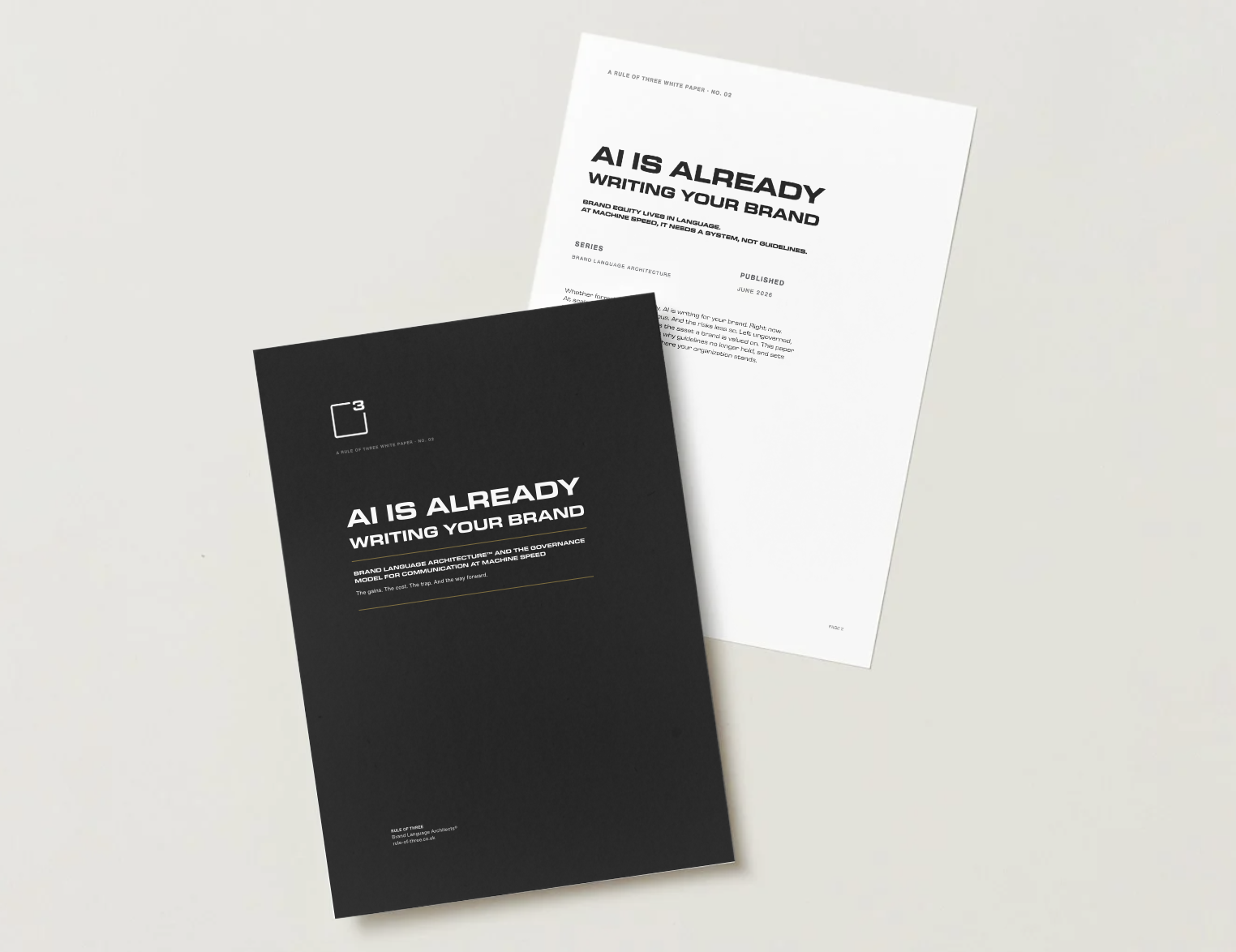
Download the white paper: AI Is Already Writing Your Brand
WHITE PAPER NO. 02: AI IS ALREADY WRITING YOUR BRAND Whether formally or informally, AI is writing for your brand today, at scale. This paper examines the exposure, explains why guidelines no longer hold, and sets out the structured way to see where your organization stands.
FURTHER READINGExplore the FAQ – the core definitions of Brand Language Architecture™.
LET'S TALKThis is the work we've been designing for – systems that give organisations the structure to communicate with clarity in the age of intelligent communication.
Interested in exploring these ideas further?
