AI IS ENFORCING A BRAND VOICE YOU NEVER DEFINED

A category of software now exists to keep AI writing on brand: it checks output, enforces tone, flags drift. It works only if one thing is already true, and for most organizations it is not.
WHAT THE TOOLS ASSUMEA tool that enforces rules needs a defined thing to enforce them against. What these platforms quietly assume is that the brand's language already exists as a system. Most organizations have something else: brand guidelines. The two feel like the same thing, because both are written down, and that is exactly why the gap goes unnoticed. The enforcement layer arrives expecting a definition and finds a document written for people to interpret.
“THE ENFORCEMENT LAYER ARRIVES EXPECTING A DEFINITION AND FINDS A DOCUMENT WRITTEN FOR PEOPLE TO INTERPRET.”THE VISUAL SIDE KNEW THISOn the visual side, the difference is already understood. A designer is given more than a line about looking modern and premium. They are given a design system: exact colours, type, spacing, components, and the rules for how they combine. It is defined to the point where a tool can apply it and a new hire can get it right on the first day, without having to guess what 'premium' is supposed to mean.
LANGUAGE NEVER GOT ITThe brand's language has almost never had that. It has a tone-of-voice document, the verbal equivalent of 'modern, confident, a bit premium'. It tells a person what to aim for and trusts them to interpret it, which works when a trained writer fills the gaps with judgement. Hand the same document to an AI tool and it does the only thing it can: it forms its own rough impression of what the words mean and writes from that. The enforcement tool sitting on top works from the same impression.
MORE SOFTWARE, SAME BLANK PAGEThe tool can still police the surface, catch a wrong word or smooth an off note. What it cannot do is supply the meaning underneath, because the meaning was never written for it to hold. The difficulty was never the AI, and a tool stacked on top is the wrong layer to fix it. The model and the enforcement tool read from the same blank page, each an interpreter of a brand no one has written down. Better interpretation, perhaps. Still interpretation.
"THE MODEL AND THE ENFORCEMENT TOOL READ FROM THE SAME BLANK PAGE, EACH AN INTERPRETER OF A BRAND NO ONE HAS WRITTEN DOWN."WHAT A SYSTEM GOVERNSA Brand Language System is the verbal equivalent of the design system. It defines the brand's language as something a machine can act on directly, so that content is generated from governed instruction rather than loose guidance. It sets down what the brand stands for, the meaning beneath the words, its knowledge base, its style and tone, and how that adapts across audiences and channels. Defined that precisely, it can be encoded into the AI tools an organization already uses. That is what the enforcement platforms were always meant to govern.
DEFINE IT, OR A PLATFORM WILLA capable tool will not wait for a definition that was never built. Many now offer to build it instead. The pitch is familiar: point the platform at the website and the back catalogue, and it will learn the brand and model the voice. The offer is seductive, and the cost stays hidden until later. Whatever the platform learns then lives inside the platform, owned by it, reached through it, refined on its terms. The most valuable asset the organization holds ends up encoded in infrastructure it does not own.
"WHATEVER THE PLATFORM LEARNS THEN LIVES INSIDE THE PLATFORM, OWNED BY IT, REFINED ON ITS TERMS."THE CHOICE UNDERNEATHSo the choice beneath all of it is simpler than the market makes it appear. Either the organization defines its brand's language in a form it owns, or it hands that work to a platform to infer, hold and quietly keep. One path keeps the asset and its meaning inside the business. The other rents it back from whoever modelled it first. Stop paying, or move to a better tool, and the working definition of the brand's own voice may not leave with it.
WHOSE TERMS Years of work go into a brand that sounds like itself. It would be a strange ending to let a vendor decide what that sounds like. The tools themselves are useful; they are waiting for the one thing only the organization can give them, which is a brand defined clearly enough to govern. The question is whether that definition gets built on the organization's terms, or inferred on someone else's.
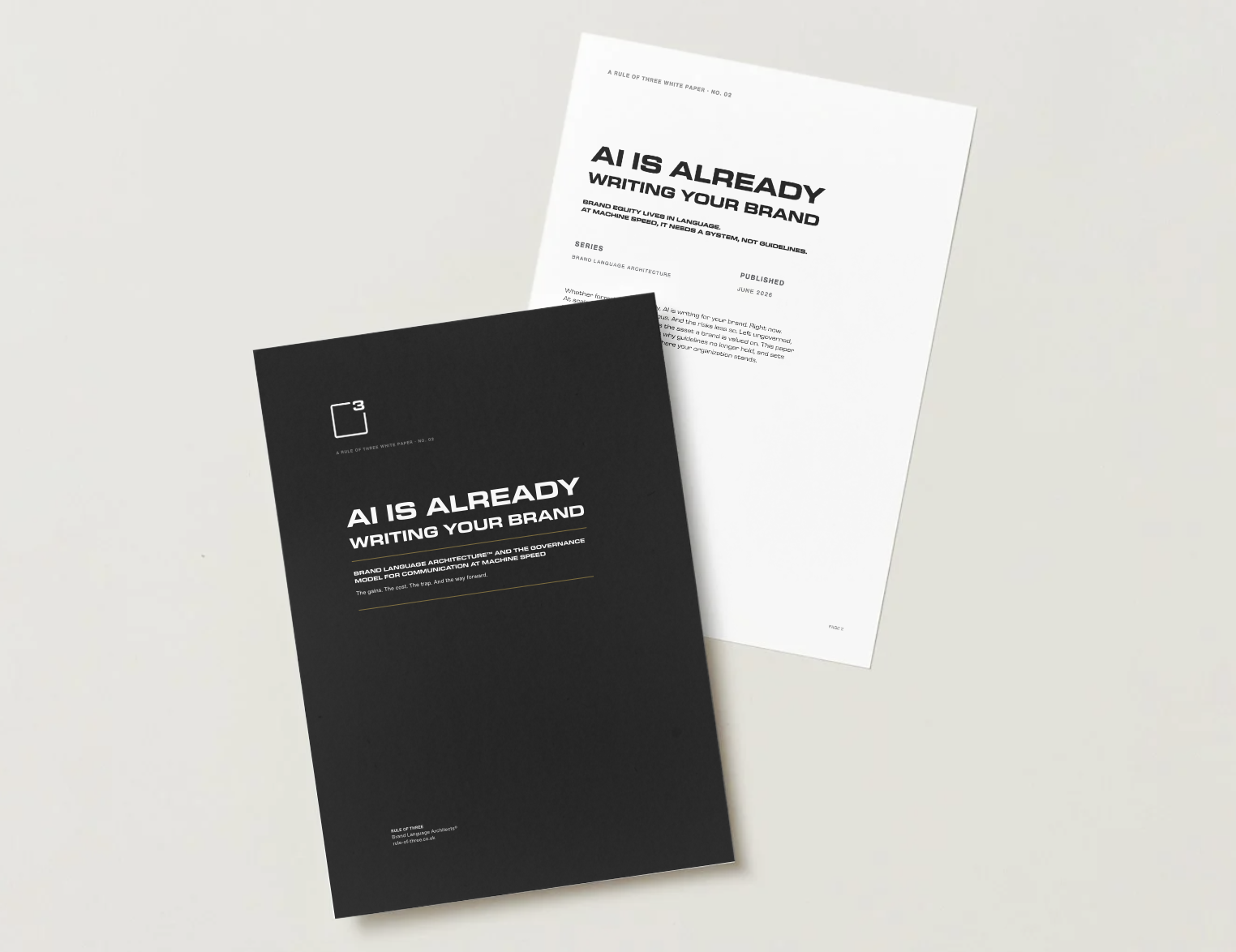
Download the white paper: AI Is Already Writing Your Brand
WHITE PAPER NO. 02: AI IS ALREADY WRITING YOUR BRAND Whether formally or informally, AI is writing for your brand today, at scale. This paper examines the exposure, explains why guidelines no longer hold, and sets out the structured way to see where your organization stands.
FURTHER READINGExplore the FAQ – the core definitions of Brand Language Architecture™.
LET'S TALKThis is the work we've been designing for – systems that give organisations the structure to communicate with clarity in the age of intelligent communication.
Interested in exploring these ideas further?
